← The Polylog Crypto Intelligence Brief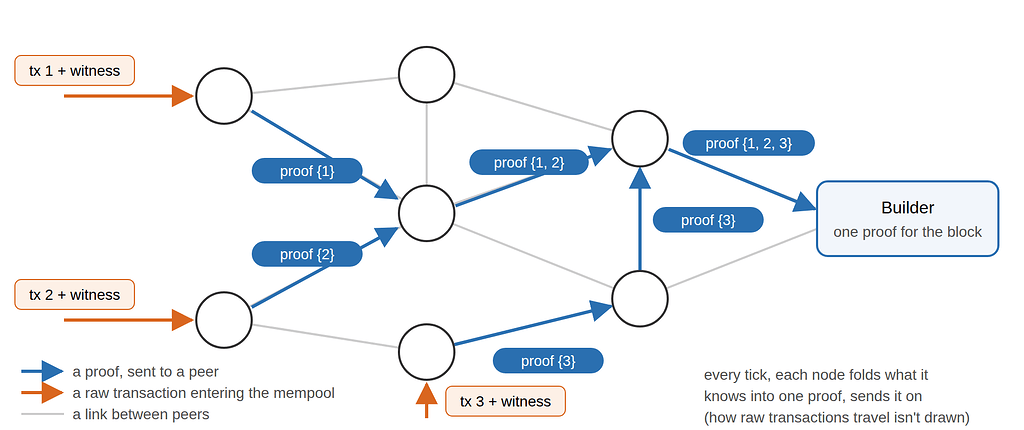
Morning Edition · Thursday, November 19, 2026Published at 12:44 AM EST · New York
Ethereum Researchers Design the Network Layer for Buterin's Post-Quantum Aggregation Proposal
EIP-8288 would let mempool nodes combine post-quantum signatures and proofs into one recursive proof, a change Vitalik Buterin says could cut a quantum-safe private transaction from about 10 million gas to the low tens of thousands.
Csaba Kiraly, an Ethereum networking researcher, published a design on Nov. 18 for the peer-to-peer side of EIP-8288. EIP-8288 is the draft Ethereum Improvement Proposal (EIP) by Vitalik Buterin and Thomas Coratger for a bandwidth-efficient mempool built on recursive STARKs (scalable transparent arguments of knowledge, a family of proofs that relies on hash functions believed to resist quantum attack).
The problem is cost. Post-quantum signatures run 2 to 3 kilobytes and cost 150,000 to 200,000 gas to verify. Buterin has said a well-engineered private transaction costs about 300,000 gas today, and roughly 10 million gas if it must also be quantum-safe, according to Decrypt. Under EIP-8288, a transaction would declare a "dependency," a 96-byte claim that a key signed a message or that some data satisfies a proof. Mempool nodes would gather these claims and produce one recursive STARK proving all of them. The specification makes a block valid only if its header carries a recursive STARK covering every dependency in every transaction. Buterin says both transaction types would then cost in the low tens of thousands of gas.
Kiraly's post addresses the question the specification leaves open: how nodes pass partial proofs to one another so that aggregation keeps up with transaction flow. A second post by Kiraly the same week, on enshrined proposer-builder separation (ePBS), proposes sending an encrypted block payload to the network before the reveal deadline and then revealing only the decryption key. A narrower earlier draft placed encrypted copies on a few nodes so the source of the payload would stay hidden.
EIP-8288 remains a draft with no activation date. Buterin wants it included in "I-star," the fork after Hegota, but neither fork has been scheduled. The proposal also depends on EIP-8141 (Frames), which is likewise unscheduled, Unchained reports.
What this means
The size and cost of post-quantum signatures function as a tax on adopting them. EIP-8288 moves that tax off the execution layer and onto mempool nodes, which would have to generate the proofs instead. …
Read more analysis
That creates a new role for whoever runs those nodes and raises a decentralization question: if proving requires specialized hardware, aggregation could concentrate among a small number of operators. Privacy applications on Ethereum's base layer stand to gain the most, since the design would cut the quantum-safe cost of a private transfer by orders of magnitude, eroding part of the cost advantage privacy rollups currently offer. Most market participants treat quantum risk as distant, and the binding constraint here is fork scheduling, not quantum hardware. The relevant precedent is EIP-4844, Ethereum's blob-data upgrade, where about two years passed between proposal and mainnet activation in March 2024. The desk's read is that EIP-8288 will likely remain in draft through Hegota, with debate over the coming months centered on prover load and bandwidth on mempool nodes rather than on the cryptography itself. This read would be wrong if core developers schedule Frames and EIP-8288 together for an early fork, or if client teams publish working aggregation prototypes on a public testnet within months.
Part of a tracked trend
Quantum Risk Moves From Theory to Crypto Roadmaps
Over the next 3-6 months, quantum-resistance becomes a concrete design and custody concern across major chains and institutional custodians, driving opt-in post-quantum schemes and 'long-dormant coin' risk discussion.
Townsquare
Start a discussion in Townsquare.
More from this edition
- Binance Wins Abu Dhabi Court Order to Recover Crypto Frozen After $6.3 Billion Hack
- Ledger Confirms Tampered Hardware Wallets in Berlin as Its Implant Investigation Reaches Europe
- Flash-Loan Liquidation Attack and a Bridge Key Change Drain About $4.48 Million on Ethereum
- Bitcoin's Testnet5 Lets Miners Build Real Blocks Under Four Proposed Consensus Cleanup Rules
- BTCPay Server Ships an Emergency Fix for Five Nginx Flaws as Remote Code Execution Research Circulates
- Miden Wraps a Private Finance Stack Around Its Bread Wallet as Aztec Ships an Anonymous Message Board
- German Judge Offers to Drop Movie2k Case if Defendant Surrenders 40,000 Bitcoin
Comments
0No comments yet.