← The Polylog Crypto Intelligence Brief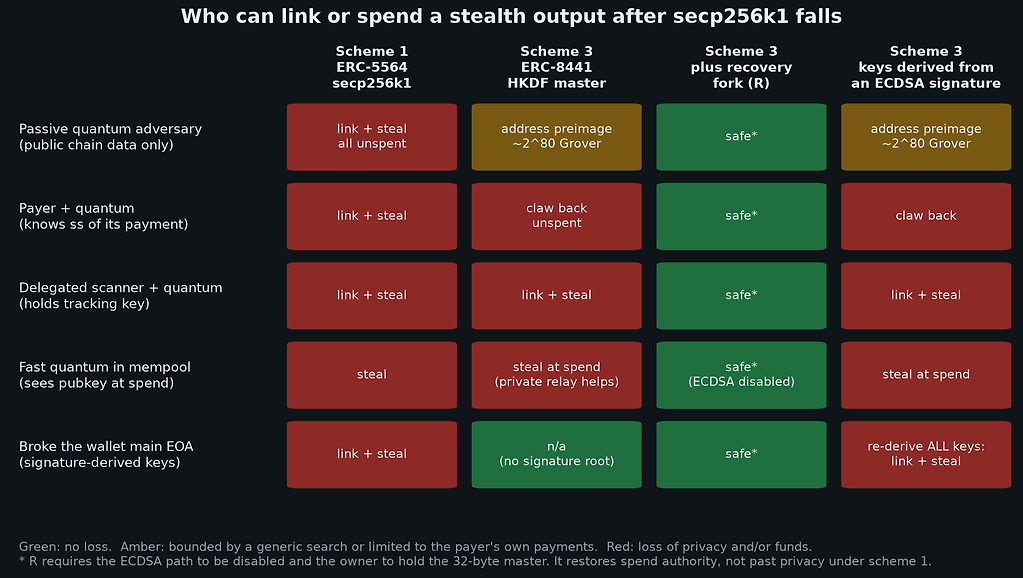
Morning Edition · Saturday, November 28, 2026Published at 12:39 AM EST · New York
Ethereum Researchers Test Post-Quantum Account Migration Paths for the Hegotá Upgrade
A separate research post warns that a quantum attacker could link and steal every unspent output under today's stealth-address standard, and it proposes a payer clawback as a fallback.
Ethereum researchers posted an experimental comparison of paths to post-quantum execution for Hegotá, the network upgrade scheduled after Glamsterdam. The authors argue that Hegotá is the opportunity to give users protocol-level tools to move their accounts to post-quantum cryptography. They report that a test network, bogota-devnet-2, already exercises much of that foundation, including Ethereum Improvement Proposal (EIP) 8141, known as Frame Transactions.
EIP-8141 is the main proposal. Its specification describes a native exit from the elliptic-curve cryptography that authenticates transactions today to post-quantum schemes, so accounts could adopt new signature types without a separate fork for each one. Core developers have scheduled EIP-8141 for inclusion in Hegotá, which is planned for 2027, although the EIP page still lists it as a draft. The design has opponents. A competing post on Ethereum Magicians argues for an alternative called SchemedTransactions. Its author says Frame Transactions make post-quantum signatures more expensive in gas because the smart-wallet path adds overhead. Those gas figures are one side's estimates. A related draft, EIP-8288, would add recursive aggregation of quantum-resistant signatures using scalable transparent arguments of knowledge (STARKs) as a mode within Frame Transactions.
A second post looks at privacy. Under Ethereum Request for Comments (ERC) 5564 scheme 1, the current stealth-address standard built on the secp256k1 curve, a quantum adversary could link and steal every unspent stealth output. The author proposes three remedies: a payer clawback, keys derived from signatures, and a zero-knowledge recovery statement for ERC-8441 outputs. The author states that the work is not a finished specification and that the recovery statement has not been built as a circuit.
Separate work on how accounts acquire code continues. A team tested draft EIP-8298, called SETCODEFROM, against mainnet bytecode. The opcode points an account's code hash at code that another contract has already deployed. The draft let any account adopt such code as often as it liked, and the testers concluded the proposal needs two new rules before it is safe.
All of these designs are opt-in. Each one requires a holder to act, so accounts whose keys are lost or whose owners never move stay exposed under the old cryptography. This desk tracks the quantum-custody thread as weakening. Today's evidence contradicts that view at the research level, because Ethereum is now writing and testing migration mechanics. Only EIP-8141, however, has a scheduled fork.
Part of a tracked trend
Quantum Risk Moves From Theory to Crypto Roadmaps
Over the next 3-6 months, quantum-resistance becomes a concrete design and custody concern across major chains and institutional custodians, driving opt-in post-quantum schemes and 'long-dormant coin' risk discussion.
Townsquare
Start a discussion in Townsquare.
More from this edition
- Chainflip Traces $12.6 Million Vault Drain to a Memory Bug in the Open-Source libzmq Library
- Binance Fully Restores Withdrawals a Month After $6.3 Billion Theft as Stolen Bitcoin Stays Beyond Any Freeze
- Bitcoin Core Developer Shows Wallet Rebroadcasts Link Addresses to Node IP Addresses
- Zcash Wallet Developers Weigh Moving Sapling Funds Into Ironwood as Ecosystem Projects Gain Outside Backing
- KuCoin Ends Monero Trading on November 30 After Cutting Off Deposits
- Spain Lets Its Financial Intelligence Unit Freeze Crypto Accounts for Five Days Without a Court Order, Bitcoin Magazine Reports
- Lighter Traces November Drain to Reused Signing Nonces as a Rounding Bug Empties a Dormant Biswap Pool
Comments
0No comments yet.