← The Global Intelligence Brief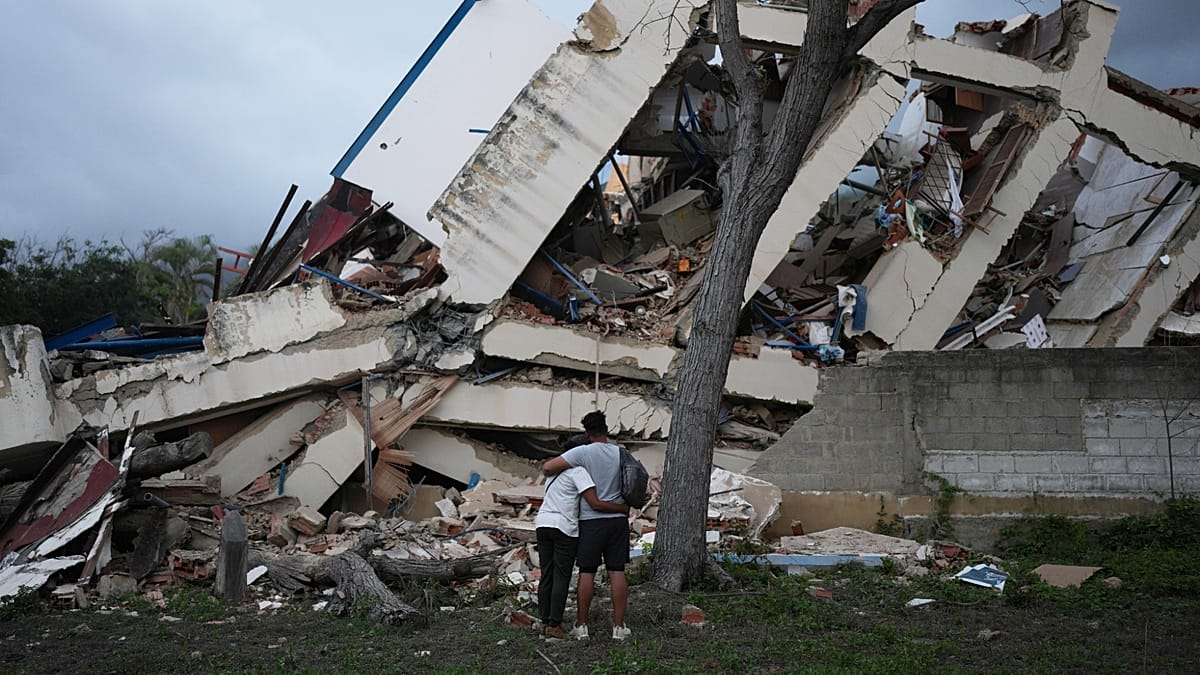


 3 sources
Morning Edition · Sunday, June 28, 2026UpdatedPublished at 5:01 PM EDT · New York
Venezuela's Quake Toll Climbs With Tens of Thousands Still Missing
The United Nations puts direct physical damage at $6.7 billion as a contested government struggles to mount a relief effort.
Updated at 5:01 PM EDT
Venezuelan authorities put the confirmed death toll at about 1,430 with nearly 3,500 injured as the rescue window closed, a figure not yet in this morning's story.
More than 68,000 people remain missing in Venezuela after twin earthquakes, the confirmed death toll has reached about 1,430 with nearly 3,500 injured, and the United Nations Development Programme has put the cost of direct physical damage at $6.7 billion, Euronews reported. Venezuelan officials said the toll continued to climb as the 72-hour window in which trapped survivors are most likely to be found drew to a close. The scale of the disaster has overwhelmed a country whose institutions were already strained.
The relief effort has become entangled in politics at home and abroad. The Guardian reported that the quakes are a test of the Trump administration's new approach to the Western Hemisphere, with Secretary of State Marco Rubio working to provide disaster response to a country whose president Washington helped depose in January, after the United States dismantled much of its main aid agency. Inside Venezuela, the New York Times reported that critics accuse interim president Delcy Rodríguez of trying to exploit the tragedy for political advantage, while her supporters make the same accusation against the opposition.
Venezuela holds some of the world's largest oil reserves, and its output has been a focus of renewed Western interest. A disaster on this scale complicates any near-term revival of production and adds a humanitarian dimension to an already politicized energy question.
Part of a tracked trend
Disasters as Political and Supply Shocks
Major natural disasters in commodity-producing states translate into political instability and supply disruptions that markets increasingly have to price, recurring as climate and geological shocks hit fragile economies.
Veracity: Plausible
73/100- If true, who benefits
Competing political actors, with the interim government seeking legitimacy through relief and Washington using aid to advance its hemisphere policy after dismantling its main aid agency.
- The nuance
The 68,000 "missing" figure is preliminary and issued by a contested government, confirmed death tolls reported elsewhere are far lower, and describing the president Washington "helped depose" states one side's account of January's events.
An open-source-intelligence read of how likely this story is true with its real nuance, not a judgment of any outlet. It assesses the claim, weighing independent and adversarial reporting. How we label confidence.
What this means
A natural disaster in a major oil state turns quickly into a political and supply problem. The damage sets back hopes for reviving Venezuelan crude output, and the contested relief effort shows how disasters in fragile economies become contests over legitimacy and foreign influence.
What to watch
Synthesized from: Euronews · The Guardian · The New York Times
Townsquare
Start a discussion in Townsquare.
More from this edition
- Oil Risk Returns to the Strait of Hormuz as US-Iran Strikes Enter a Fourth Day
- Iran Strikes Gulf Tanker and US Bases in Bahrain and Kuwait, Drawing American Retaliation
- BIS Warns AI Spending Boom Could End in a Prolonged Investment Bust
- Ukraine Strikes Two More Russian Oil Refineries as Energy War Continues
- Kazakhstan Courts Washington With Tungsten Deal, Calling Trump 'Sent by Heaven'
- China Removes Tariffs on 53 African Countries as It Courts the Continent
- Indonesia Plans to Cut State Companies From About 1,000 to 250
- Spain Adds Russia to Its Tax-Haven List and Drops Gibraltar After 35 Years
Comments
0No comments yet.