← The Global Intelligence Brief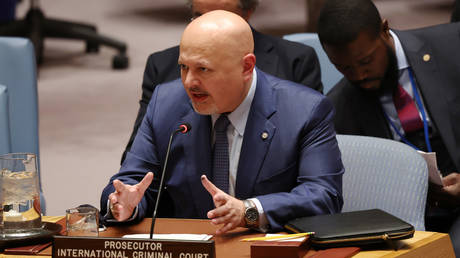
 1 source
Morning Edition · Sunday, July 26, 2026UpdatedPublished at 7:03 AM EDT · New York
International Criminal Court Dismisses Chief Prosecutor Karim Khan Over Misconduct Allegations
The removal leaves the court without its top prosecutor at a moment when its authority is contested by major powers.
Updated at 7:03 AM EDT
Multiple independent outlets confirmed the dismissal, reporting that 82 of the ICC's 125 member states voted to remove Khan for serious misconduct, an allegation he denies.
The International Criminal Court in The Hague dismissed its chief prosecutor, Karim Khan, over allegations of sexual misconduct, an account first reported by RT and since confirmed by multiple independent outlets. A majority of the court's member states, 82 of its 125 members, voted to remove him after finding he had committed serious misconduct and a serious breach of duty. Khan had led the court's most politically sensitive investigations, and his removal leaves the institution without its senior prosecutor at a time when its legitimacy is already disputed.
The court occupies a fraught position in a fragmenting world order. It has issued charges against leaders of major powers, and several of those states, including the United States and Russia, reject its jurisdiction outright. A misconduct scandal at the top of its prosecution gives critics further reason to question its standing, whatever the merits of the underlying allegations.
Diplomats said the allegation concerned an inappropriate sexual relationship with a junior lawyer at the court, which Khan denies. The process to elect a successor is not expected to conclude before next year, and the timing compounds an existing crisis of authority for one of the central institutions of the postwar legal order.
Veracity: Corroborated
91/100- If true, who benefits
States that already reject the court's jurisdiction, including the United States, Russia, and Israel, which gain rhetorical cover to question its authority at a moment it is prosecuting sensitive cases.
- The nuance
The dismissal is corroborated well beyond the single Russian source cited, through an 82-of-125 member-state vote reported by France 24, United Nations News, and others, but Khan denies the allegations, is challenging the removal, and had earlier been cleared by judges, and some describe the case as politically driven.
An open-source-intelligence read of how likely this story is true with its real nuance, not a judgment of any outlet. It assesses the claim, weighing independent and adversarial reporting. How we label confidence.
What this means
International institutions that lose credibility accelerate the drift toward a world where power, not law, settles disputes, which raises political risk for cross-border commerce and investment. The court's authority weakens, the major powers that already reject it gain rhetorical cover, and the broader loser is the predictability that global rules are meant to provide. The channel is institutional legitimacy, the underlying framework that supports sanctions, war-crimes accountability, and the norms investors assume when they operate across borders.
Source: RT
Townsquare
Start a discussion in Townsquare.
More from this edition
- Brent Falls Toward $92 as US-Iran Strike Pause Holds a Second Night
- Gold Holds Near $4,066 as Warsh's Fed Firms the Dollar and Tilts Toward a September Hike
- India's Education Minister Resigns, the First Cabinet Exit Forced by Protest Under Modi
- Iran Accuses Ukraine of Bombing One of Its Ships in the Caspian, Widening the War's Map
- Trade Blocs Harden as China Splits the EU and US Tariffs Hit Seven Southeast Asian States
- Chinese Investors Use Crypto Exchanges to Bypass Beijing's Controls on AI Stocks
- Defense Giants Are Funding Military Start-Ups as Drones Rewrite the Battlefield
Comments
0No comments yet.