← The Global Intelligence Brief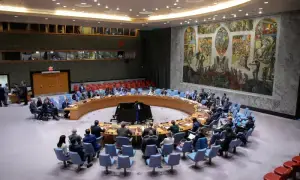
Morning Edition · Wednesday, July 29, 2026Published at 1:17 AM EDT · New York
US Diplomats Walk Out of UN Security Council as France Criticizes Washington's Rights Record
The rare public breach between the two Western allies followed a United States vote alongside Russia and North Korea against extending the United Nations human-rights chief's term.
United States diplomats walked out of a United Nations Security Council meeting as France's ambassador began to speak, a public confrontation between two longtime allies, Dawn reported. The dispute began when the United States joined Russia and North Korea in voting against extending the term of Volker Turk, the United Nations High Commissioner for Human Rights. France's mission then compared the United States position to those of the two governments.
A United States representative accused France of feigning moral outrage and lecturing other members on subjects ranging from the Ukraine war to human rights. Behind the friction is Trump's complaint that European states did not assist the United States during the Iran war and declined direct participation, as United States coverage noted. Russia offered its own account of the discord among allies, with a foreign-ministry official quoted by TASS arguing that Ukraine's leadership is using the Iran crisis to extract more money from the European Union, a claim Kyiv rejects.
Whatever the immediate trigger, the walkout displayed a widening rift within the Western alliance and the declining authority of the institution meant to contain such disputes.
Veracity: Corroborated
87/100- If true, who benefits
Russia's narrative of a fracturing Western alliance gains, reinforcing the case for a multipolar order in which multilateral institutions carry less authority.
- The nuance
The walkout and vote are confirmed, but the United States voted alongside Nicaragua and Mali as well as Russia and North Korea, and the TASS assertion that Kyiv is exploiting the Iran crisis is a Russian foreign-ministry claim that Ukraine denies.
An open-source-intelligence read of how likely this story is true with its real nuance, not a judgment of any outlet. It assesses the claim, weighing independent and adversarial reporting. How we label confidence.
What this means
The exposed party is the rules-based order itself and the assets that assume its stability, because open discord among permanent Security Council members erodes the body's ability to arbitrate crises and pushes states toward power-based bargaining. The channel is credibility. When the United States and a close ally clash publicly, and Washington aligns with Russia and North Korea on a human-rights vote, other governments come to see multilateral institutions as weaker guarantors. That accelerates a shift toward a multipolar order in which alliances are more transactional and less predictable for investors pricing geopolitical risk.
Townsquare
Start a discussion in Townsquare.
More from this edition
- SK Hynix Profit Miss Deepens Global Retreat From AI Chip Stocks as Fed Decision Nears
- Iran Fires Missiles at US Forces in Jordan as Washington and Riyadh Strike Iraq, Lifting Oil
- Ukraine Retools Long-Range Drone Strikes to Keep Russian Refineries Offline Longer
- India's Larsen & Toubro Lifts Profit 14 Percent as Domestic Demand Cushions Global Tech Selloff
- China Holds Six of the Ten Most Innovative Humanoid-Robot Startups, Patent Study Finds
- Trump Hosts Netanyahu for Seventh White House Visit as Israel Heads Toward October Election
- Iran to Receive Chinese Shoulder-Launched Missiles Within Weeks, Sources Say
Comments
0No comments yet.