← The Global Intelligence Brief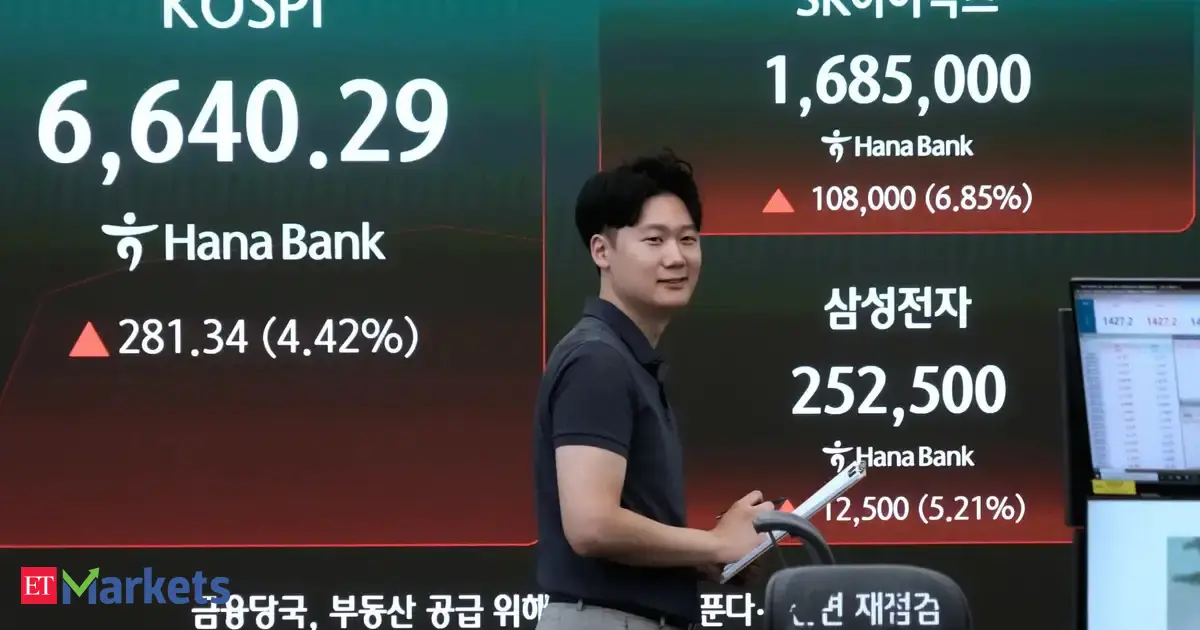


 4 sources
Morning Edition · Thursday, August 6, 2026UpdatedPublished at 7:02 AM EDT · New York
South Korea's Kospi Falls About 5 Percent as the Global Chip Selloff Reaches Asia
SK Hynix closed down 10.4 percent and Samsung Electronics 6.3 percent as the Kospi ended 4.6 percent lower, while the Kosdaq held its level and the Korea Exchange halted program selling.
Updated at 7:02 AM EDT
The Korean market closed: the Kospi ended 4.6 percent lower, with SK Hynix finishing down 10.37 percent and Samsung down 6.3 percent, both worse than their intraday levels, while the Kosdaq held firm.
South Korean equities led a decline across Asian markets on Thursday, and the selling deepened into the close. The Kospi fell as much as 5 percent during the session and finished 4.6 percent lower, and the Korea Exchange activated the safeguard that suspends program sell orders after a sharp drop (its sell-side sidecar), the Korea JoongAng Daily reported. SK Hynix ended the day down 10.37 percent and Samsung Electronics down 6.3 percent, according to the Korea JoongAng Daily, wider losses than the 8.27 percent and 5.69 percent the two shares had shown at one point earlier in the session, which TradingKey recorded. Foreign investors did the selling, and KED Global reported that the Kosdaq, which carries a far smaller weighting in memory and logic chipmakers, held its level while the Kospi fell. India's Economic Times reported that the losses were concentrated among Korean retail investors, some of whom said publicly they would not buy stocks again.
The decline began in New York. The Dow Jones Industrial Average rose 0.49 percent on Wednesday to close at 54,349.12, while the S&P 500 slipped 0.17 percent to 7,723.55 and the Nasdaq Composite fell 0.83 percent to 26,363.44. Memory-chip maker SanDisk reported strong fourth-quarter revenue but guided below expectations for the coming quarter, which lowered investor expectations across the memory-chip sector that Samsung and SK Hynix dominate. Israeli daily Globes wrote on Thursday that Asian markets were falling and Korea led the decline, that Wall Street and oil prices were steady, and that two Israeli-listed technology companies, Taboola and SolarEdge, together lost more than a billion dollars of market value overnight.
The divergence matters more than the level. Europe's STOXX Europe 600 closed at 656.86 on Tuesday, helped by falling oil prices and corporate earnings, and Euronews catalogued the year's best performers across the index. Indices with a broad industrial and financial base are climbing at the same time that indices concentrated in memory and logic chips are falling. The same split appeared inside Korea on Thursday, with the Kosdaq steady while the chipmakers that dominate the Kospi dropped by double digits. That is a rotation out of the narrow group of stocks that drove global benchmarks higher over the past two years, not a general withdrawal from equities.
Traders also faced a supply event on Thursday. The first lockup on SpaceX shares expired, making a large tranche of insider stock eligible for sale, though the company staggered the schedule so that holders may sell only the first 20 percent of eligible shares on the initial date. CoinDesk put the figure at about $101 billion, while The Motley Fool counted 911.5 million shares. Other estimates ranged as high as $123 billion depending on the share price used. The stock had already fallen below its offering price in July, Axios reported, as the expiry approached.
What this means
Korean and Taiwanese indices carry the highest concentration in memory and logic chipmakers of any major market, so a guidance miss anywhere in the memory supply chain transmits directly into their benchmarks and into the household savings invested in them. The channel is earnings expectations rather than rates: investors are marking down the future revenue attached to artificial-intelligence capital spending, not repricing discount rates. European and American indices with broader sector weights absorb the same news with far smaller moves, which is why the STOXX Europe 600 and the Dow Jones Industrial Average rose in the same week that the Kospi fell 5 percent.
What to watch
- Whether SpaceX shares fall further once insider stock can actually be sold, because that would show how much appetite exists to absorb new supply in the most heavily promoted frontier-technology name.
- Guidance from the next round of memory and equipment makers, since a second below-consensus outlook would confirm that the demand miss is industry-wide rather than company-specific.
- Whether Korean retail investors keep selling, because a sustained withdrawal by domestic buyers removes the group that has cushioned previous foreign selloffs in Seoul.
Observations to monitor, not financial advice.
Synthesized from: Economic Times · Globes (Hebrew) · CoinDesk · Euronews
Townsquare
Start a discussion in Townsquare.
More from this edition
- Shipping Industry Asks the United Nations to Block Hormuz Transit Fees as Reopening Deal Nears
- Two Israeli Reservists Killed in South Lebanon, the First Israeli Deaths Since the June Truce, as Rome Talks Break Off
- Washington Has Repaid $100 Billion in Tariffs the Supreme Court Struck Down
- Bitcoin Holds Above $64,000 While Ether Trades Below What Holders Paid
- The Rhine Falls Toward Its Lowest Recorded Level, Raising Freight Costs Across German Industry
- Russia Says It Struck Two More Cargo Ships Near Odesa as the Black Sea Trade Route Comes Under Sustained Attack
- Trump Says American Munitions Stocks Are Ample as Reports Describe a Pentagon Crisis Meeting
Comments
0No comments yet.