← The Global Intelligence Brief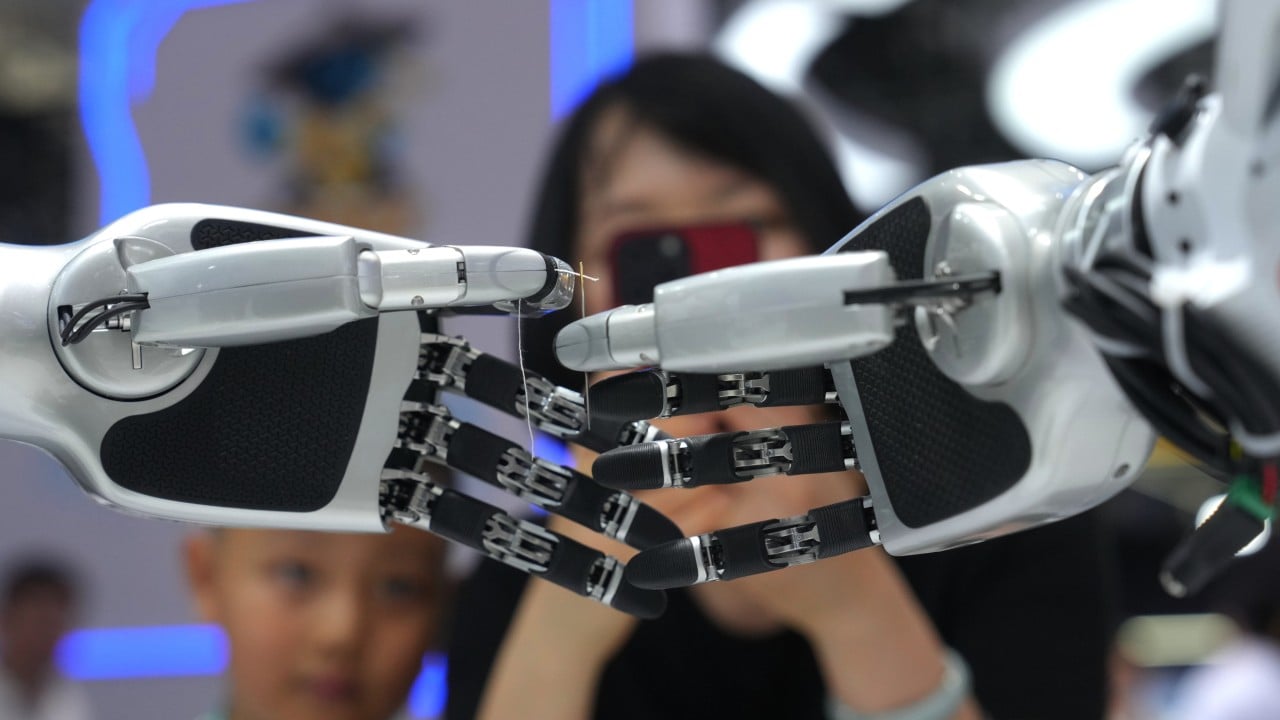

 3 sources
Morning Edition · Sunday, August 23, 2026Published at 1:11 AM EDT · New York
Chinese Robot Makers Shift From Humanoid Demonstrations to Machines Built for Work
A humanoid ran 100 metres in 9.39 seconds at a Beijing competition, but manufacturers at the World Robot Conference put wheeled and task-specific designs at the centre of their pitch.
A Chinese humanoid robot covered 100 metres in 9.39 seconds at the humanoid games, faster than Usain Bolt's human record of 9.58 seconds, in a demonstration staged for cameras rather than a comparable athletic event.
The commercial message at this year's World Robot Conference in Beijing was more restrained. Humanoids drew the crowds, but Chinese makers emphasised practical design, and wheeled machines received more emphasis as the industry moved from demonstration to deployment, according to the South China Morning Post. Wheels are cheaper, more reliable and adequate for most warehouse and inspection tasks, which is the constraint that decides purchases.
The same publication reported a parallel trend among Chinese office workers, where non-programmers are building their own artificial-intelligence tools, driven mainly by concern about falling behind as technology reshapes their work. Courses and tutorials have multiplied around that anxiety.
Both stories describe adoption arriving from the bottom of the market. Chinese robotics firms are competing on unit cost and reliability at a moment when Western investors are questioning the return on large artificial-intelligence capital spending, and chip stocks are falling.
Part of a tracked trend
China Builds a Parallel Technology Stack
United States export controls push China to develop its own chips, computing hardware and artificial-intelligence systems, accelerating a split of global technology into competing spheres that reshapes supply chains and standards.
Veracity: Corroborated
78/100- If true, who benefits
Chinese robotics firms and state media gain a demonstration that supports export ambitions and domestic capital raising, and Beijing gains evidence that export controls on high-end semiconductors are not constraining industrial automation, while Western robotics vendors selling at higher price points lose the argument on cost.
- The nuance
The 9.39-second run by Tiangong Ultra is confirmed by Reuters and the Global Times, but it was a preliminary heat under organiser-set conditions rather than a sanctioned athletic event, which makes the comparison with Usain Bolt's 9.58 seconds a presentational claim, and the separate assertion that wheeled machines are displacing humanoids commercially rests on conference impressions rather than published order books.
An open-source-intelligence read of how likely this story is true with its real nuance, not a judgment of any outlet. It assesses the claim, weighing independent and adversarial reporting. How we label confidence.
What this means
Cheap wheeled robots and low-cost internal software tools raise Chinese industrial productivity without requiring the most advanced semiconductors, which weakens the leverage of export controls designed around high-end chips. Firms exposed on the positive side are Chinese component and integration suppliers selling into domestic factories and logistics operators. Exposed on the other side are Western robotics and automation vendors whose price points assume customers cannot buy a workable machine for a fraction of the cost.
Synthesized from: South China Morning Post · Al Jazeera · South China Morning Post
Townsquare
Start a discussion in Townsquare.
More from this edition
- Canada Sets September 8 Tariffs on US Steel and Electronics After 50 Percent American Levies Take Effect
- Thirty-Year Treasury Yield Near Highest Since 2007 as Gold Holds Above 4,500 Dollars and Bitcoin Adds 22 Percent
- Russian Crude Passes Half of India's Oil Imports as Middle East War Reshapes Supply
- Iran's Security Chief Threatens Gulf Oil Routes That Bypass Hormuz as a Cyberattack on a British Plant Is Reported
- Drone Debris Sets Fire to an Ozon Warehouse in Orenburg, the Second Strike on Russian E-Commerce Logistics in Two Days
- Magnitude 5.9 Earthquake Under Ibaraki Shakes Tokyo and Injures Dozens
- Pakistan Collects Record 15 Billion Rupees at the Khunjerab Pass as Tariffs Redraw Asian Trade Routes
Comments
0No comments yet.