← The Global Intelligence Brief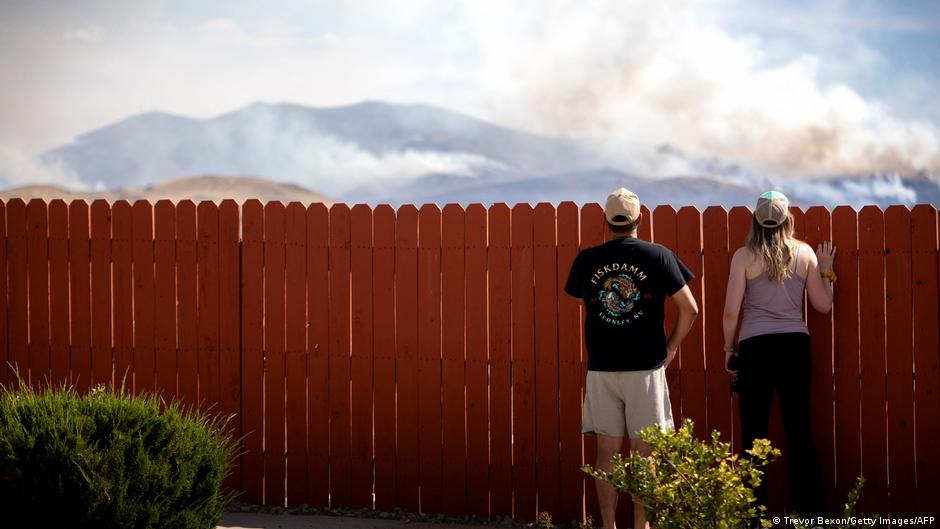


 3 sources
Morning Edition · Monday, August 24, 2026UpdatedPublished at 7:37 AM EDT · New York
Heat, Fire and Quake Losses Land on Public Budgets From Nevada to Sumatra
A German climate-policy analyst told Russian state media that southern and western European Union economies could produce 7 percent less output by 2030 because of heat waves, as up to 90,000 people are urged to evacuate a fast-growing, uncontained wildfire near Reno.
Updated at 7:37 AM EDT
The Reno-area fire has since been named (the Hawk Fire), has grown past 15,000 acres at zero percent containment, and has prompted a state of emergency and a Nevada National Guard deployment.
A wind-driven wildfire near Reno, Nevada, since named the Hawk Fire, has forced tens of thousands of people from their homes and destroyed houses. The fire had burned more than 15,000 acres and remained at zero percent containment as of Sunday evening, according to CNN. Officials said the fire was human-caused but have not disclosed further detail on its origin. Roughly 42,000 people are under mandatory evacuation orders and a further 45,000 are in warning zones told to prepare to leave, putting the total urged to evacuate near 90,000, Deutsche Welle reported and NPR reported. Nevada Governor Joe Lombardo declared a state of emergency in Washoe County and mobilised the Nevada National Guard, including two helicopter crews and 60 troops to help police secure evacuated neighbourhoods, while the utility NV Energy cut power to about 60,000 customers in northwest Reno as a precaution, with crews still working in extreme conditions.
In Indonesia, President Prabowo Subianto is travelling to Sumatra to inspect wildfire response operations after visiting fire-affected areas of Kalimantan, Antara reported. Pertamina's trading arm has separately opened a free 24-hour clinic for people affected by an earthquake in East Nusa Tenggara, an example of a state-owned energy company absorbing a disaster-relief function.
The cumulative economic estimate comes from Europe. The German political scientist and independent climate-policy analyst Jan Kaspar told TASS that frequent heat waves could leave gross domestic product in southern and western European Union member states about 7 percent lower by 2030 than it would otherwise be, the agency reported. That figure is one analyst's projection rather than an official forecast, and it describes forgone output rather than a contraction.
The common feature across the three cases is who pays. Heat-related productivity loss, smoke, non-damage business interruption and evacuation costs largely fall outside standard property insurance, which leaves them with companies, households and governments.
Veracity: Plausible
68/100- If true, who benefits
Climate-policy advocates gain a quantified economic argument, Russian state media gains a framing in which European economies are structurally weakening, and utilities and insurers gain from attention moving toward public budgets rather than toward their own liability.
- The nuance
The Reno evacuation figure holds up in United States reporting, which also records that investigators found the fire was human-caused, a fact the climate framing omits, and the 7 percent output figure is not one analyst's original projection but a restatement of an Allianz Trade estimate for the most heat-exposed European economies that has circulated since June, passed here through a Russian state agency.
An open-source-intelligence read of how likely this story is true with its real nuance, not a judgment of any outlet. It assesses the claim, weighing independent and adversarial reporting. How we label confidence.
What this means
Losses that insurance does not cover do not disappear. They land on corporate margins and public budgets instead. Utilities face liability and grid costs in fire-prone regions, agricultural and construction employers lose working hours to heat, and governments in Indonesia and elsewhere fund relief directly or through state-owned enterprises. Reinsurers avoid these specific perils, so the fiscal channel, not the insurance channel, transmits the shock.
Synthesized from: Deutsche Welle · TASS · Antara
Townsquare
Start a discussion in Townsquare.
More from this edition
- Treasury's Doubled Buyback Fails to Pull Down Long Yields, and Money Moves to Hard Assets
- Bitcoin Holds Above $77,000 After Its Largest Weekly Gain in Two Years
- Washington Names India in a Tariff-Evasion Crackdown as Delhi's Security Adviser Lands in Beijing
- US Sanctions Iran's Shipping, Oil and Gold Links as Tehran Threatens to Seize Ships in Hormuz
- Ukraine Hits Russian E-Commerce Warehouses for a Third Night as Moscow Strikes Odesa's Port
- Britain's New Prime Minister Goes to Kyiv as Europe Co-Chairs a Meeting Washington Is Not Leading
- Asian Technology Shares Fall as Alibaba Sells $10.2 Billion of Stock at a Discount
Comments
0No comments yet.