← The Global Intelligence Brief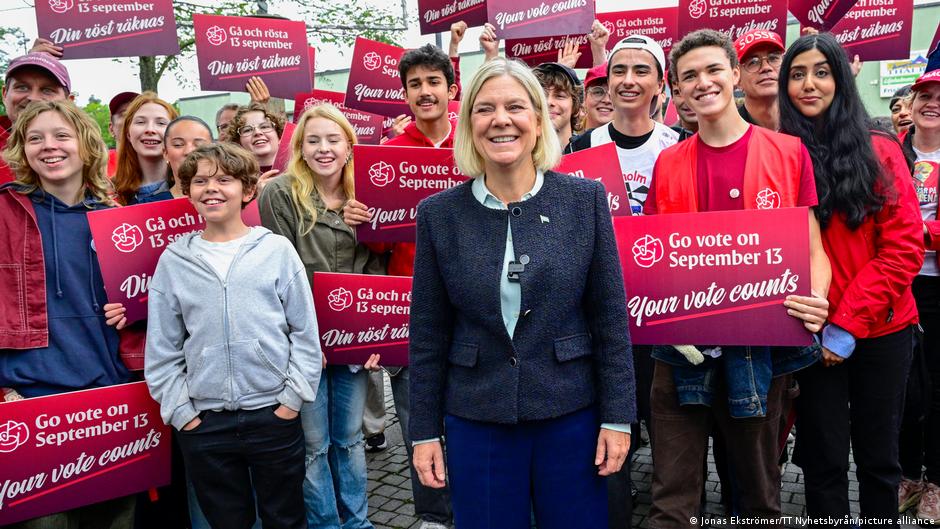

 2 sources
Morning Edition · Sunday, September 13, 2026Published at 1:20 AM EDT · New York
Sweden Votes in a Race That Could Put the Sweden Democrats in Cabinet for the First Time
Polls published Friday put the four centre-left parties at 49.3 to 50.8 percent against 47.6 to 49 percent for the governing bloc, with one survey projecting a one-seat margin.
Swedes vote today in an election that will decide whether the Sweden Democrats enter national government for the first time. Deutsche Welle reported that the party would take cabinet posts if Prime Minister Ulf Kristersson's bloc wins, under an arrangement agreed in April, while the centre-left opposition led by former prime minister Magdalena Andersson has seen its lead narrow.
The race is close. Three polls published Friday put the four centre-left parties at between 49.3 and 50.8 percent against 47.6 to 49 percent for the governing parties and their Sweden Democrat allies, according to the Atlantic Council, with one survey projecting a margin of a single seat in the 349-member Riksdag. The Sweden Democrats finished ahead of Kristersson's Moderates in 2022 and have supported the government from outside the cabinet since.
The Financial Times argues that the broader European shift reflects generational change, with younger voters who have no direct memory of communism or fascism treating both as history rather than as a boundary on acceptable politics. That reading applies across the continent, where parties once excluded from coalitions now hold or share power in several member states.
Part of a tracked trend
Europe's Governing Right Realigns
Parties once excluded from European coalitions keep entering government as generational memory of the twentieth century fades, so European Union decisions on budgets, migration and external funding become progressively harder to reach and slower to execute.
Veracity: Corroborated
92/100- If true, who benefits
Whichever bloc wins gains a mandate on migration and defence spending, and parties across Europe that have been excluded from cabinets gain a precedent if the Sweden Democrats take portfolios.
- The nuance
The polling range, the one-seat projection and the April agreement to give the Sweden Democrats cabinet posts are confirmed by the Atlantic Council primer and Al Jazeera, but polls at that margin do not resolve the outcome, and the Financial Times generational thesis the article repeats is one interpretation of the European shift rather than a finding.
An open-source-intelligence read of how likely this story is true with its real nuance, not a judgment of any outlet. It assesses the claim, weighing independent and adversarial reporting. How we label confidence.
What this means
Sweden runs one of Europe's more disciplined fiscal positions and holds a currency outside the euro, so a change in governing coalition affects defence procurement, migration policy and the krona's risk premium more than it affects sovereign creditworthiness. The wider consequence is for European Union decision-making, which requires consensus on budgets, enlargement and Ukraine funding. Each national government that includes a party sceptical of those commitments makes collective decisions slower and their outcomes less predictable for anyone pricing European assets.
Synthesized from: Deutsche Welle · Financial Times
Townsquare
Start a discussion in Townsquare.
More from this edition
- Saudi Arabia Loses Its Hormuz Bypass as Houthis Complete Control of Bab al-Mandeb
- Warsh's Fed Meets This Week With a Rate Increase Priced at Roughly Two in Three
- Iraq Seizes Drone Platform Linked to Saudi Pipeline Attack as Tehran Says It Is Not at War With Riyadh
- BRICS Adopts New Delhi Declaration Urging Restraint Without Naming the US Strikes on Iran
- Houthi Control of Bab al-Mandeb Leaves Washington With No Cheap Options
- Drones Strike Tatarstan Petrochemical City, With Casualty Accounts in Dispute
- Amodei Calls for a Slower AI Race, and Altman and Musk Say They Agree
- Executives Warn Private Equity Funds Raised in the Cheap-Money Years Will Miss Their Targets
Comments
0No comments yet.