← The Global Intelligence Brief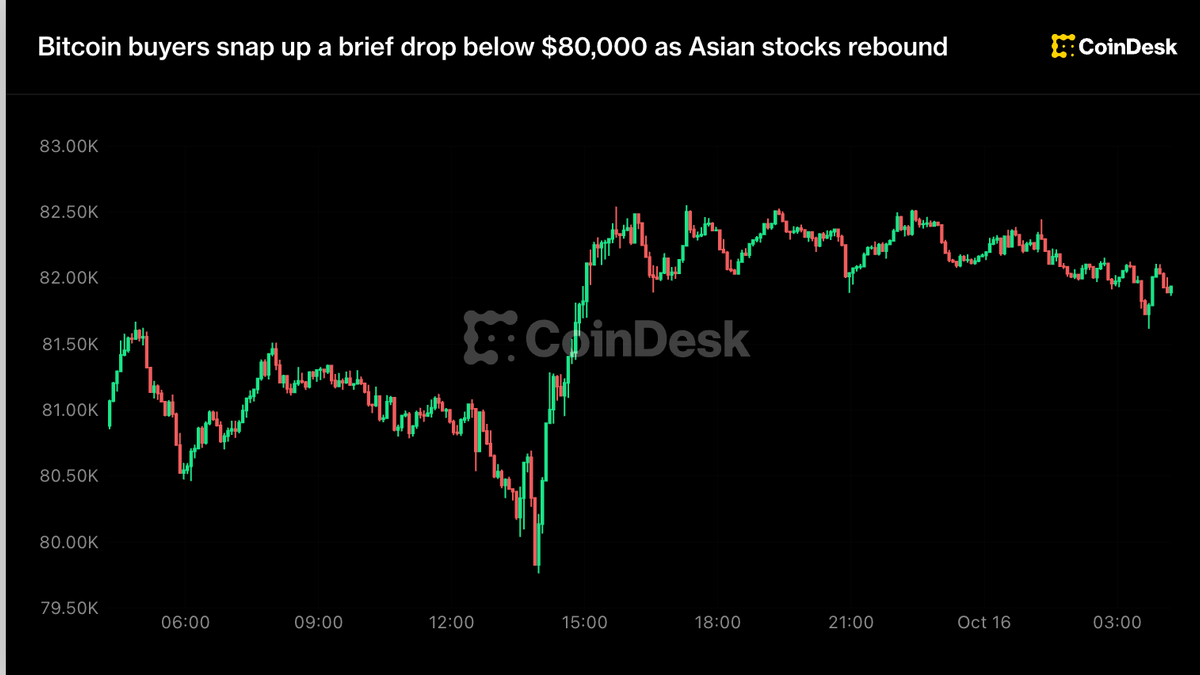

 3 sources
Morning Edition · Friday, October 16, 2026Published at 1:18 AM EDT · New York
Bitcoin falls below $80,000 and recovers to $82,500 alongside Seoul chip stocks while silver extends a 12% monthly decline
Gold slipped about 0.4% to near $4,155 an ounce on Friday as US 10-year yields above 5% raised the cost of holding assets that pay no interest.
Bitcoin's price action on Friday resembled that of a volatile technology stock more than that of a monetary asset. It dropped briefly below $80,000 and returned to $82,500 within two hours, CoinDesk reported. The rebound came as chipmakers in Seoul recovered from their worst close since April. Buyers returned to both markets at the same time, for the same reason: a fall in US bond yields that eased the pressure on assets priced on future growth.
The precious metals did not share in the rebound. Silver fell to $57.17 an ounce, down 0.41% on the day and 12.3% over the past month, although it remains about 10% above its level a year ago. Gold traded near $4,155, down about 0.4%, according to Indian market reports of Friday's rates. With the 10-year Treasury yield at 5.085% and US consumer inflation at 3.7%, investors who hold metal give up a positive real return on government bonds. That cost has grown as the market prices a possible Fed hike.
The industry case that bitcoin has matured rests on volatility. Grayscale research cited by Bitcoin Magazine shows that bitcoin's realized volatility now falls within the range of a number of S&P 500 stocks. That supports the claim that bitcoin has become a more ordinary asset. It does not support the claim that bitcoin acts as a hedge, because lower volatility and correlation with chip stocks describe a risk asset, not a monetary metal.
Separately, law enforcement continued acting against crypto fraud. The Brooklyn district attorney's office said it took 112 servers and 241 fake sites offline in an operation against a crypto scam network, which Bitcoin Magazine called one of the largest cyber takedowns by a local prosecutor.
Part of a tracked trend
Bitcoin Trades as a Risk Asset, Not Digital Gold
At each geopolitical or inflationary stress point, bitcoin keeps trading with liquidity-sensitive risk assets rather than with monetary metals, so the digital-gold framing continues to fail exactly when investors most want it to hold.
What this means
Bitcoin and the precious metals are responding to the same input, US real interest rates, but through different channels. Bitcoin is priced by the same leveraged and liquidity-sensitive buyers who hold AI equities, so it falls and recovers with them. Gold and silver are priced against the real return on Treasuries, so they weaken when yields rise. Silver's 12% monthly fall reflects its double role as an industrial metal and a monetary one. It is exposed both to rising rates and to the AI and manufacturing slowdown now visible in Korean chip stocks. The common view treats bitcoin as a war and inflation hedge. Friday's trading again shows it moving with Seoul's chipmakers. The precedent is 2022, when bitcoin fell by more than half as the Fed raised rates while gold ended the year close to flat. The likelier outcome over the next month is that bitcoin continues to track AI equities and that gold holds up better than silver if Fed hike expectations firm. That depends on Treasury yields staying above 5%. It would be proved wrong if bitcoin rises on a day of falling equities and rising Gulf tension, which would be the first evidence of the hedge behavior its holders claim.
What to watch
- Bitcoin's moves on days when the Kospi or the Nasdaq falls sharply. Continued joint declines confirm risk-asset behavior, and a split would mark a change.
- Silver against gold. A further fall in silver relative to gold would show that industrial demand worries now outweigh monetary demand.
- Central-bank gold purchase reports for the third quarter. Continued official buying at these prices would show that reserve managers are buying regardless of US rates.
Observations to monitor, not financial advice.
Synthesized from: CoinDesk · Bitcoin Magazine · Bitcoin Magazine
Townsquare
Start a discussion in Townsquare.
More from this edition
- CoreWeave's default insurance reaches distress levels as the AI debt sell-off spreads to South Korea's Kospi
- Fed Chair Warsh gives no signal on an October move after US consumer prices rise 3.7% from a year earlier
- WTI crude jumps 3% on a large US inventory draw while Brent stalls as Washington weighs easing Russian tanker sanctions
- Zelensky says Ukraine will resume strikes on Russian refineries as Trump says the war will be settled without him
- Bank of Japan's Koeda says the neutral rate is "considerably above 1%" and warns the board against excessive caution
- EU revives debate on confiscating frozen Russian assets as Belgium maintains its objection before the October 23-24 summit
- Israeli officials weigh an Iran strike plan covering energy and missile sites, but reports say action before the October 27 election is unlikely
Comments
0No comments yet.