← The Global Intelligence Brief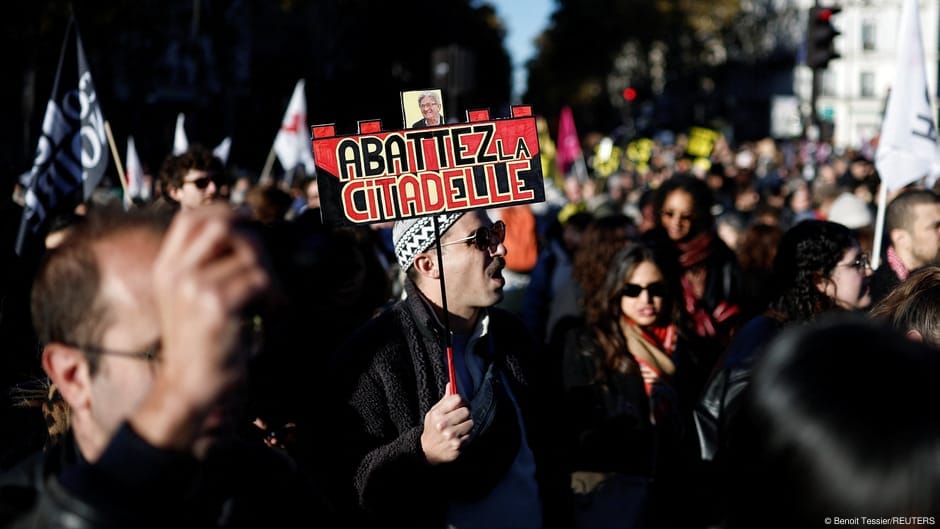


 3 sources
Morning Edition · Sunday, November 15, 2026Published at 12:16 AM EST · New York
France's Protests Reach a Fifth Weekend With 106,000 Marchers as Pension Costs Drive the Budget Fight
Turnout was the lowest in recent weeks, but a stabbing of a university vice-president near Paris and an argument between generations over pension spending keep pressure on the government.
About 106,000 people marched through French cities on Saturday, the fifth weekend of protests in a row, Deutsche Welle reported. It was the lowest turnout in recent weeks. The movement began in mid-September with students protesting overcrowded classrooms and teacher shortages. It then grew to include public workers seeking better pensions and relief from fuel and living costs, and on November 5 unions held a nationwide strike against the government's austerity budget.
Police are searching for a masked attacker who stabbed a university vice-president near Paris, RT reported, placing the attack in the context of the nationwide student protests. Authorities have not publicly linked the attacker to the protest movement.
The New York Times described the conflict as a "generational clash". Retirees are living longer, so governments must spend more on pensions, and that leaves less money for schools and other services that younger voters use. Prime Minister Sébastien Lecornu survived two no-confidence votes after freezing a contested pension reform, Brussels Signal reported. Freezing the reform kept the government in office, but it kept pension spending at the level the reform was supposed to reduce.
Russian state media covers French unrest closely because it fits Moscow's account of a divided West. That interest is information about Moscow's goals. It does not change the facts on the ground, which DW and the Times report in similar terms.
Part of a tracked trend
The Long-End Revolt
Governments will keep reaching for balance-sheet tools to suppress long-term yields, and bond markets will keep repricing duration higher anyway, so each intervention transfers demand into scarce assets instead of lowering borrowing costs.
Veracity: Plausible
74/100- If true, who benefits
If the protests keep up pressure on the budget, opposition parties and unions gain leverage over Prime Minister Sébastien Lecornu's minority government, and investors betting on a wider gap between French and German yields stand to profit.
- The nuance
The 106,000 figure is the Interior Ministry's count, while organizers claimed about 200,000. The stabbing at the University of Versailles Saint-Quentin-en-Yvelines appears only in RT's report, and police have not connected it to the protests.
An open-source-intelligence read of how likely this story is true with its real nuance, not a judgment of any outlet. It assesses the claim, weighing independent and adversarial reporting. How we label confidence.
What this means
The financial channel is French government debt. Each budget concession on pensions widens the deficit that the bond market has to fund. Each austerity measure brings more people into the street and weakens a minority government. Holders of long-dated French bonds, French banks that hold large amounts of their own government's debt, and the European Central Bank (ECB) are exposed, because the ECB may face pressure to support French debt if yields rise. Investors already know France has a deficit problem. They tend to assume the ECB will always step in. The ECB's tools come with conditions that a government unable to pass a budget would have trouble meeting. The likelier outcome over the coming months is a diluted budget that leaves the pension freeze in place, and investors demanding more yield over German debt to hold French debt. That depends on the protests continuing to shrink, as Saturday's turnout suggests. The read would be wrong if Lecornu passed a budget with credible pension savings, which would narrow the gap with German yields.
Synthesized from: Deutsche Welle · The New York Times · RT
Townsquare
Start a discussion in Townsquare.
More from this edition
- Houthi Missiles Target Riyadh and Iran Says Two Tankers Hit Mines Near Hormuz, Days After Oil's Second Weekly Loss
- Iran's Revolutionary Guards Say Six Drones Hit a US Radar in Bahrain, and Bahrain Says It Repelled the Attack
- Bitcoin Falls Below $63,000, 26% Under Its October Peak, as Fund Outflows and Forced Selling Continue
- Markets Price a December Fed Rate Increase as US Producer Prices Rise 6.5% in a Year
- Nvidia Faces Lawsuit Exposure and Security Questions After Jensen Huang's Exit, With Earnings and Anthropic's Stock Listing Due This Week
- Kremlin Says It Will Not Block a European Team at Ukraine Talks as Kushner Cites Ideas That Could Bring a Breakthrough
- Drones Hit Russia's Nizhnekamsk Refining Hub as Three Merchant Ships Are Struck Off Romania
Comments
0No comments yet.