← The Global Intelligence Brief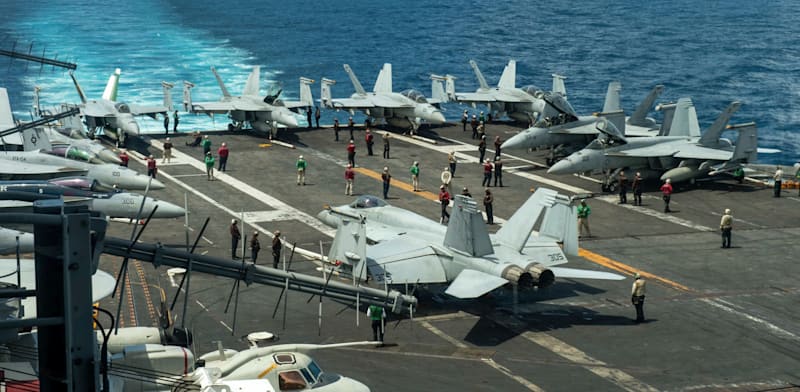


 4 sources
Morning Edition · Monday, November 16, 2026Published at 12:11 AM EST · New York
Brent holds near $95 as traders weigh a forecast supply surplus against Iranian claims of tanker mine strikes in Hormuz
A third US aircraft carrier entered the Middle East command area on Sunday, while US shale producers keep consolidating on revenue gained since the Iran war began.
Brent crude traded near $95.25 a barrel in early Asian trading on Monday, down about 0.6%, JournalArta reported, after settling at $95.84 on Friday at the end of a second straight weekly loss. Analysts expect the global market to move into surplus by the end of the fourth quarter, the Economic Times reported. The paper warned that this expectation could still prove wrong.
Iran's Islamic Revolutionary Guard Corps (IRGC) says shipping through the Strait of Hormuz has become more dangerous. The IRGC said two oil tankers using what it called an "unauthorised route" in the south of the strait struck naval mines, and that one, a supertanker carrying more than two million barrels, sank, The New Arab reported. No independent source has confirmed the incidents. Globes reported that a tanker struck a mine and caught fire. The same report said the carrier USS Theodore Roosevelt entered the area of US Central Command (CENTCOM) on Sunday evening, joining the George H.W. Bush and George Washington. The United States enforces a naval blockade of Iranian ports and says it has cleared mines from the strait's main routes.
The price has fallen despite these reports. That suggests traders give limited weight to the IRGC's claims, or expect any lost Gulf supply to be replaced elsewhere. The IRGC's description of some routes as "unauthorised" amounts to Tehran claiming the power to decide which shipping lanes are lawful, and insurers price that claim whether or not a given strike happened.
American producers are among the winners. US oil and gas companies have earned about $130 billion more since the war began in February, as buyers have switched to other suppliers, OilPrice reported. Diamondback Energy is close to a $5 billion deal to expand drilling in the Permian Basin, the Financial Times reported.
Part of a tracked trend
Hormuz Chokepoint Repricing
Recurring Gulf conflict forces energy exporters and importers to build costly workarounds around the Strait of Hormuz, permanently raising the risk premium embedded in Gulf trade and infrastructure.
Veracity: Developing
22/100- If true, who benefits
If the IRGC's account holds, Tehran establishes a claim to decide which Gulf shipping lanes are lawful and raises insurance costs on its rivals' cargoes. US shale producers gain as buyers look for supply outside the Gulf.
- The nuance
The IRGC has reported a series of tanker mine strikes since August, often through Iranian state media, that no shipowner, insurer or ship-tracking service has publicly confirmed. US Central Command denied an earlier IRGC supertanker claim and said it had seen the IRGC preparing to lay mines. The reported sinking therefore rests on the word of one side in the war.
An open-source-intelligence read of how likely this story is true with its real nuance, not a judgment of any outlet. It assesses the claim, weighing independent and adversarial reporting. How we label confidence.
What this means
The oil price reflects two forces working against each other. Expected supply growth pushes it down, and the risk of attacks on Gulf shipping pushes it up, mainly through insurance and freight costs. US shale producers and their acquirers gain from both: high prices raise their revenue, and Gulf risk makes buyers want suppliers outside the region. Importers in Asia, such as India, pay more. The consensus reading of the price decline is that the war premium is fading. The desk reads it differently. The premium has moved out of the headline crude price and into shipping costs and long-term supply contracts, which do not show up on a screen. The 1987 to 1988 "tanker war" is the relevant precedent. Mines and attacks continued under US naval escort, yet crude prices stayed moderate because supply was ample, while insurance costs for Gulf cargoes stayed high. The likelier outcome is that Brent stays in a range near current levels for the coming weeks while Gulf freight and insurance stay high and US shale deals continue. That holds if no attack is confirmed on a major tanker in the US-escorted lanes. An independently verified mine strike in a lane the US says it has cleared would invalidate this read and push the risk back into crude prices.
Synthesized from: Economic Times · Globes (Hebrew) · OilPrice · Financial Times Markets
Townsquare
Start a discussion in Townsquare.
More from this edition
- Gold falls below $3,900 and silver hits a yearly low as markets price a December Fed rate increase
- Nvidia's leadership crisis reaches Washington as Huang weighs a return and Bessent demands answers
- China's October retail sales grow 0.4% and factory output slows to 4.8%, both below forecasts
- Saudi-backed Yemeni forces withdraw from Bab el-Mandeb, leaving the Houthis in control of the Red Sea's southern entrance
- Kremlin says Putin, Xi and Trump will meet in Shenzhen on November 19 as Europe seeks a seat at Ukraine talks
- Bank of Japan's Takata urges an early rate increase as the economy shrinks and the yen weakens past 160 per dollar
- Bitcoin trades near $65,000 after a weekend drop to its lowest level since July
Comments
0No comments yet.