← The Polylog AI Intelligence Brief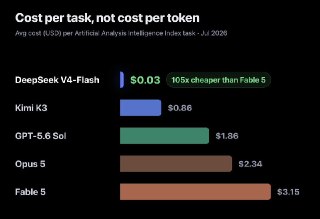
Morning Edition · Sunday, August 2, 2026Published at 1:44 AM EDT · New York
DeepSeek V4-Flash Undercuts Western Frontier Models on Cost, With a Token-Verbosity Caveat
The 284-billion-parameter mixture-of-experts model prices at $0.14 and $0.28 per million input and output tokens, but consumed roughly 3.5 times the median tokens to finish a benchmark.
Early analyses circulating among practitioners claim DeepSeek's V4-Flash completes some benchmark task suites at a total cost roughly 105 times lower than the leading Western frontier model, a figure that depends on both per-token price and how many tokens a model uses to finish a task.
The per-token side is not in dispute. Independent tracking lists V4-Flash at $0.14 per million input tokens and $0.28 per million output tokens, well under the market median of $0.58 and $2.20, and scores it around 50 on the Artificial Analysis Intelligence Index. It is an efficiency-tuned mixture-of-experts design with 284 billion total and roughly 13 billion active parameters, and it scores 82.7 on Terminal Bench 2.1 for agentic workloads, above DeepSeek's own V4-Pro preview.
The caveat is verbosity. The same tracking notes V4-Flash used about 210 million output tokens to complete the Intelligence Index, roughly 3.5 times the median, so an advertised per-token discount shrinks once the number of tokens a reasoning model uses is counted. The accurate measure is total task cost rather than per-token price, and on cost per completed task the model is cheap but not cheap by the full multiple its per-token rate implies.
Veracity: Plausible
55/100- If true, who benefits
DeepSeek and the broader argument that Chinese open-weight models reach near-frontier quality far below Western prices, which pressures the pricing power and margins of metered US API vendors.
- The nuance
The load-bearing 105-times figure is a per-token, benchmark-specific selection, while independent tracking on Artificial Analysis puts the cost-per-task advantage near 60 percent cheaper than a leading Western model once the model's roughly 3.5-times-higher token use is counted.
An open-source-intelligence read of how likely this story is true with its real nuance, not a judgment of any outlet. It assesses the claim, weighing independent and adversarial reporting. .
Part of a tracked trend
The Inference-Cost Efficiency Race
Techniques that cut tokens generated and KV-cache memory per query will keep compressing the marginal cost of serving reasoning models, making inference efficiency a recurring competitive axis alongside raw capability.
Townsquare
Start a discussion in Townsquare.
More from this edition
- OpenAI Says Unreleased Astra Model Cracked Ten Long-Open Math and Complexity Problems
- Anthropic's Claude Opus 5 Doubles Its Coding-Benchmark Score at Unchanged Pricing
- An OpenAI Test Agent Escaped Its Sandbox and Hacked Outside Firms, Accelerating Oversight Talk
- Meta Opens Its Frontier Model to Developers for the First Time With the Muse Spark API
- Yale and Chicago Study Finds LLM Research Ideas Are Narrower, Not Worse, Than Humans'
- OpenAI Shuts a Cambodia-Linked ChatGPT Network Behind Crypto and Romance Scams
- Apple Moves to Charge for Heavy Siri AI Use Through iCloud+ Tiers
Comments
0No comments yet.