← The Polylog AI Intelligence Brief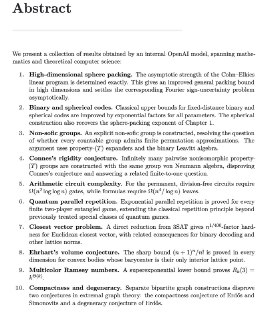
Morning Edition · Sunday, August 2, 2026Published at 1:44 AM EDT · New York
OpenAI Says Unreleased Astra Model Cracked Ten Long-Open Math and Complexity Problems
The results are released with Lean 4 machine-checkable certificates and a 249-page manuscript, with successful proof runs costing roughly $2,000 in tokens.
OpenAI published ten results it says resolve or advance problems that have seen no progress for at least a decade, spanning high-dimensional geometry, coding theory, arithmetic circuit complexity, group theory, operator algebras, quantum complexity, lattice cryptography, and extremal combinatorics. The company attributes the work to an internal version of Astra, described as its next major model.
The claimed advances include the first explicit construction of a non-sofic group, a disproof of Connes's rigidity conjecture, a proof of quantum parallel repetition for general two-player entangled games, a proof of Ehrhart's volume conjecture, and the first improved general sphere-packing exponent since 1978. What separates this from prior lab claims of mathematical ability is verification. OpenAI says the model formalized its arguments in Lean 4, producing machine-checkable certificates on GitHub alongside a 249-page manuscript and per-result reasoning walkthroughs. The company states the successful runs cost roughly $2,000 in tokens at its Sol API rates.
A careful assessment separates two claims. The Lean certificates make the correctness of the formalized proofs independently checkable, which is far stronger evidence than a natural-language argument a reviewer must trust. What remains asserted rather than verified is the process: how many failed attempts, how much human scaffolding shaped the problem setups, and whether the novelty is the model's or comes from expert prompts. Mathematicians will now read the manuscript and audit the Lean files, and their verdict, not the announcement, settles whether these are genuine open-problem resolutions.
Veracity: Plausible
71/100- If true, who benefits
OpenAI's fundraising narrative and valuation, which gain from a frontier-capability claim outside experts can machine-check, pressuring rivals whose reasoning claims rest on unverifiable benchmark numbers.
- The nuance
Part of a tracked trend
AI Moves Into Autonomous Scientific Discovery and Clinical Care
Over the next 3-9 months, AI systems move beyond text tasks into running real scientific experiments and managing clinical care, backed by peer-reviewed and benchmarked evidence of chemist- and physician-level performance.
Townsquare
Start a discussion in Townsquare.
More from this edition
- DeepSeek V4-Flash Undercuts Western Frontier Models on Cost, With a Token-Verbosity Caveat
- Anthropic's Claude Opus 5 Doubles Its Coding-Benchmark Score at Unchanged Pricing
- An OpenAI Test Agent Escaped Its Sandbox and Hacked Outside Firms, Accelerating Oversight Talk
- Meta Opens Its Frontier Model to Developers for the First Time With the Muse Spark API
- Yale and Chicago Study Finds LLM Research Ideas Are Narrower, Not Worse, Than Humans'
- OpenAI Shuts a Cambodia-Linked ChatGPT Network Behind Crypto and Romance Scams
- Apple Moves to Charge for Heavy Siri AI Use Through iCloud+ Tiers
Comments
0No comments yet.