← The Polylog AI Intelligence Brief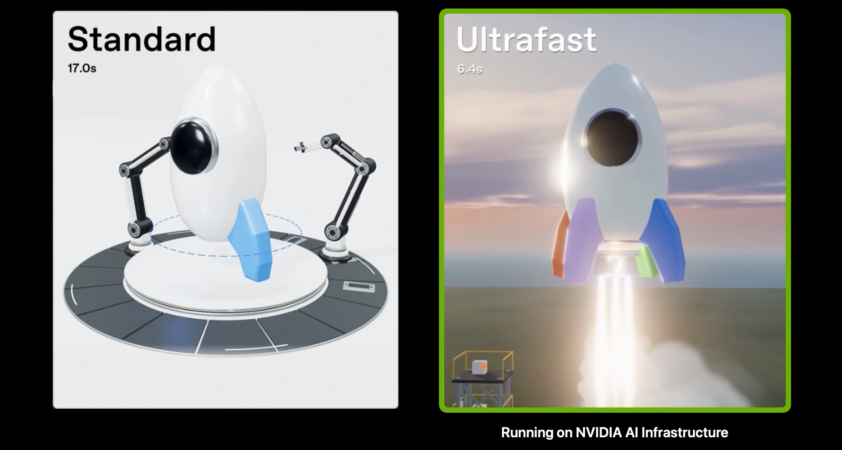
Morning Edition · Saturday, October 3, 2026Published at 2:33 AM EDT · New York
OpenAI Sells Latency as a Product, Charging Six Times Standard Rates for GPT-6 Astra Ultrafast
The tier runs on Nvidia Blackwell GPUs at roughly 300 tokens per second. It lists at $60 per million input tokens and $300 per million output tokens for short-context prompts.
GPT-6 Astra Ultrafast is now live in the OpenAI API and available to eligible ChatGPT Work and Codex users. Nvidia says the tier generates tokens up to eight times faster than the standard Astra tier in Codex and up to six times faster through the API, running on Blackwell GPUs with kernel-level work done jointly with OpenAI's inference team. VentureBeat reports the tier runs around 300 tokens per second and that a separate model, GPT-6.1 Sol, delivers Astra-like quality at roughly a fifth of the price.
The pricing matters most for anyone budgeting agent workloads. Ultrafast bills at six times the standard rate, which comes to $60 per million input tokens and $300 per million output tokens on short-context prompts. OpenAI is therefore cutting the price of comparable intelligence through Sol while charging a steep premium for that same intelligence delivered faster. Capability and speed are now priced as separate variables.
OpenAI's model guide for the GPT-6 family, published Thursday, functions as the operating manual for this segmentation. It tells developers to match model choice and reasoning effort to task difficulty, reserve Astra for the hardest reasoning, route repetitive extraction and classification tasks to Luna, and use prompt caching, compaction, mid-turn steering, asynchronous tool calls, and multi-agent delegation to keep long-running work affordable. The guidance comes from OpenAI itself, and the speed multipliers come from Nvidia and OpenAI rather than from independent measurement.
Nvidia had a clear interest in publicizing the collaboration. Its shares rose 1.09% on October 1 to close at $230.86 after the announcement, according to IBTimes UK. For coding agents, the appeal is concrete: faster token generation shortens edit-test-debug cycles and reduces the idle time between tool calls, which is where interactive agent sessions lose the most real time.
What this means
The underlying mechanism is price discrimination based on serving speed rather than on model quality. This lets OpenAI defend revenue per query while cutting headline intelligence prices through cheaper tiers like Sol. The parties exposed are inference competitors that cannot match Blackwell-class throughput, and agent startups whose unit economics assume a single price for a single capability level. The precedent is cloud storage and database tiering, where latency classes became durable revenue lines once the underlying capability became commoditized. Over the coming months, the likelier path is that rivals launch their own latency tiers and that enterprise procurement teams begin specifying tokens per second alongside benchmark scores, provided interactive agent workloads keep growing faster than batch workloads. This reading would weaken if third-party measurements show the Ultrafast speed gap closing on standard hardware, which would make a six-times premium difficult to justify.
Part of a tracked trend
Frontier Model Price War
Frontier API vendors increasingly compete on strategic price-cutting rather than pure capability, repeatedly launching or repricing models below prevailing rates to grab share and compressing industry inference margins; expect recurring below-rival pricing moves.
Townsquare
Start a discussion in Townsquare.
More from this edition
- OpenAI Says It Blocked a Campaign to Extract Hidden Reasoning Traces, Naming People Linked to Moonshot AI
- Google Ships Gemini 4 Argon to Cyber Defenders First, Without Cyber Guardrails
- Nvidia's 64GB DGX Spark Lists at $4,999, Above Last Year's 128GB Launch Price
- Cloudflare Trains Its First Models and Releases Them as Open-Weight Decision Engines
- The Same Agent Model Scores 62% in One Harness and 33% in Another
- Anthropic Tightens Enforcement Against VPN Access, Suspending Claude Accounts in Hong Kong
- Anthropic Holds Sonnet Pricing Flat and Sells the Token Savings Instead
Comments
0No comments yet.