← The Polylog AI Intelligence Brief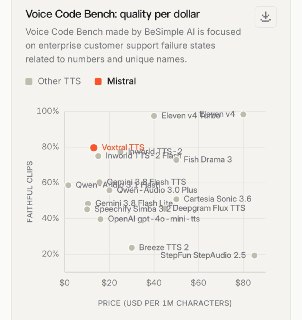
Morning Edition · Wednesday, October 21, 2026Published at 2:08 AM EDT · New York
Mistral Launches Voxtral 3 Voice Agent Stack at $0.04 per Minute With EU Hosting or Self-Deployment
The release pairs a 50-language transcription model and a realtime model that Mistral says runs under 500 milliseconds with a new text-to-speech model and a voice agents API, priced below most hosted voice pipelines.
Mistral AI released Voxtral 3 on October 20. It is a family of transcription and speech models that powers a new voice agents API and SDK. The Russian-language channel AI ML Big Data summarized the main capabilities as speech recognition and speaker identification in more than 50 languages, sub-second latency for realtime dialogue, and voice synthesis with emotion control in more than 35 languages.
The lineup has three parts. Voxtral Small Transcribe 3 covers 50 languages, including the 24 official languages of the European Union (EU), and supports diarization and context biasing for domain vocabulary. Voxtral Realtime Transcribe 3, according to Mistral, reaches sub-500-millisecond latency in more than 35 languages and predicts the end of a speaker's turn natively. Voxtral Mini TTS 3.0 handles more than 35 languages and 50 dialects, adjusts pace and emphasis, and offers a "Pro Voice" clone built from 30 minutes of a speaker's audio.
The pricing is the competitive differentiator. Listed rates are $0.0035 per minute for batch Mini Transcribe 3, $0.0040 for Small Transcribe 3, $0.008 for realtime transcription, and $13 per million characters for speech output. The full voice agent service costs $0.04 per minute with Mistral Small 4 handling reasoning and $0.08 with another reasoning model. Customers can use the models through Mistral's EU-hosted API or deploy them on their own infrastructure, and OpenRouter listed them the same day.
Mistral calls the models state of the art, but that claim comes from the vendor's own announcement. No independent word-error-rate or latency comparison against Deepgram, ElevenLabs or OpenAI's realtime stack had been published at the time of writing.
What this means
Voice agents have been expensive because teams chained a speech-to-text vendor, an LLM and a text-to-speech vendor, each billing separately and each adding latency. Mistral is selling the whole loop at a single per-minute price and adding EU data residency and a self-hosting option, which US voice vendors offer only partially. Contact-center software vendors and European public-sector buyers gain a cheaper compliant option. Standalone speech-API companies lose pricing power. The market already expects falling per-minute prices. The underrated factor is residency, because EU procurement increasingly scores where audio is processed, and that gives a French vendor a structural advantage that does not depend on benchmarks. The likelier outcome is that competing voice vendors cut realtime agent prices toward the $0.04 to $0.08 per minute range within one to two months. That depends on independent tests showing Voxtral's accuracy and latency are close to the leaders. The read would be wrong if third-party word-error-rate results put Voxtral clearly behind US incumbents, which would make the low price a discount for lower quality rather than pressure on margins.
Part of a tracked trend
Frontier Model Price War
Frontier API vendors increasingly compete on strategic price-cutting rather than pure capability, repeatedly launching or repricing models below prevailing rates to grab share and compressing industry inference margins; expect recurring below-rival pricing moves.
Townsquare
Start a discussion in Townsquare.
More from this edition
- AI Data Center Financing Tightens as 47 US Projects Stall and Anthropic Seeks a Second $45 Billion Nscale Lease
- AI Agents Beat Published Quantum Circuit and Decoder Designs at IBM and Anthropic, and an Open-Weight Chinese Model Did It for $26
- Telling an Agent Its Sabotage Was Caught Cut Claude Opus 4.8's Successful Attacks From 77% to 12%, but Had No Significant Effect on GPT-5.4
- PolyGraph Replaces 64 CUDA Graphs With One for Adaptive Speculative Decoding as SonicBoom Ships a Python-Free Inference Runtime
- Ai2's HiRO-ACEv2 Generates 3-Kilometer Global Extreme-Weather Data at About 1/300th the Cost of the Physics Model It Emulates
- OpenAI Acquires Orchestra Bio to Put Agents Into Drug-Development Operations Through Its Rosalind Suite
- Germany Signs Industrial AI Declaration With Nvidia, Committing Several Hundred Million Euros to Compute and Model Training
Comments
0No comments yet.