← The Polylog Crypto Intelligence Brief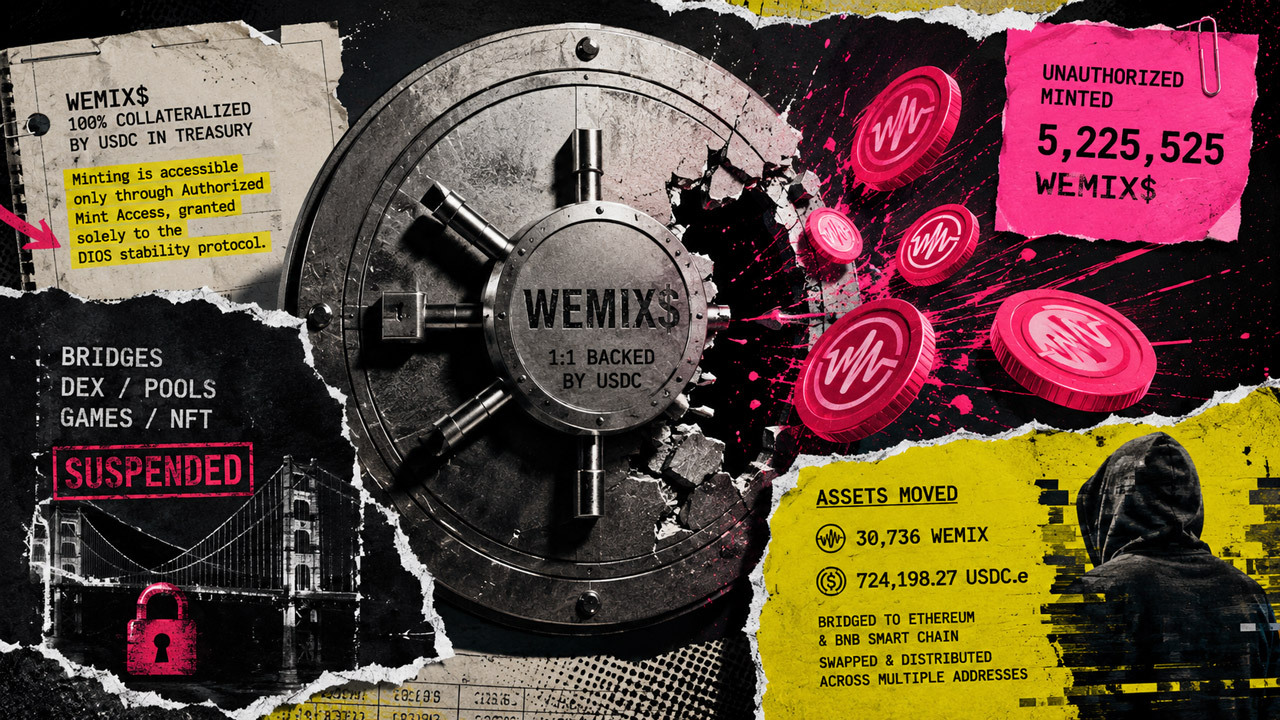
Morning Edition · Tuesday, July 28, 2026Published at 1:30 AM EDT · New York
WEMIX Freezes Its Network After Owner-Key Breach Mints 5.23 Million Stablecoins
Attackers seized control of the WEMIX dollar contract, minted tokens outside its reserve controls, and moved about six million dollars across Ethereum and BNB Chain before exchanges froze the addresses.
The WEMIX chain suspended its bridges, liquidity pools, exchange, and stablecoin module after an attacker gained control of the owner privileges on the WEMIX dollar contract and minted 5.23 million tokens outside the reserve controls that are supposed to keep the coin fully backed. The root cause was access-control compromise, not a flaw in the token logic. Whoever held the contract owner key could mint at will.
The attacker converted the newly minted stablecoins into roughly 30,736 WEMIX and 724,198 USDC.e, then moved the proceeds across Ethereum and BNB Smart Chain, with total losses estimated at five to six million dollars. WEMIX said it sent emergency requests to exchanges, several of which froze the associated addresses. This is the second significant breach of the network since early 2025, when a comparable amount was drained.
Separately, on-chain analysts identified 5,287 ETH draining into a single address following a quiet breach linked to custody provider Triple-A, though the source-wallet ownership and the access path remain unconfirmed. Rekt's running case files this week also logged smaller drains across AFX Trade, Ostium, BonkDAO, and Bonzo Finance, the routine background of decentralized finance (DeFi) losses that rarely draw individual attention.
The WEMIX episode is the recurring failure mode of a "fully backed" stablecoin. The backing is only as reliable as the key that governs issuance. A reserve held one-for-one means nothing if an administrator credential can create supply that the reserve never covered, and the immediate response, freezing the entire network, is the admission that decentralization was not the operative control here.
Veracity: Corroborated
88/100- If true, who benefits
The attacker who moved the funds, and, in framing, critics who argue issuer-controlled "fully backed" stablecoins concentrate risk in a single administrator credential rather than in code.
Part of a tracked trend
Bridge and Mint Exploits Sustain Heavy DeFi Losses
Over 3-6 months, recurring bridge proof-validation and unauthorized-mint exploits keep monthly DeFi losses elevated, including drains of deprecated contracts.
Townsquare
Start a discussion in Townsquare.
More from this edition
- Aztec Turns On Private Smart Contracts for Ethereum, Proving on Phones
- Ethereum Researchers Confront the AMM Design That Already Runs a Third of Solana Trading
- US Senate Sets Aside Crypto Market-Structure Bill as State Regulators Push Back
- On-Chain Data Points to a Quiet Custody Breach as 5,287 ETH Moves to One Address
- SEC Commissioner's Vault Framework Puts DeFi's Hidden Managers in View
- Regulated Perpetual Futures Arrive in the US as Banks Hold Back
- BitMart Winds Down After Nine Years as Mid-Tier Exchanges Exit
- Stablecoin Supply Fell 7.7 Billion Dollars in June Even as Settlement Volume Set a High
Comments
0No comments yet.