← The Global Intelligence Brief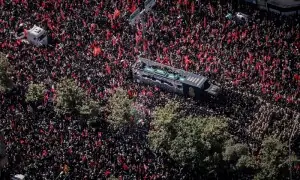


 3 sources
Morning Edition · Monday, July 6, 2026Published at 6:15 AM EDT · New York
Millions Fill Tehran for Khamenei's Funeral as Iran Balances Mourning and Negotiation
The large state turnout for a leader killed in the war with Israel projects unity, even as Tehran keeps negotiating with Washington and oil prices remain low.
Vast crowds moved through Tehran on Monday for the funeral procession of Ayatollah Ali Khamenei, Iran's supreme leader, who was killed in a strike during the war with Israel earlier this year. Authorities estimated the turnout in the millions, numbers that Dawn reported could rival the funeral for the republic's founder nearly four decades ago. The coffins were carried across the capital toward Mehrabad International Airport in a procession expected to last some 12 hours, according to The Hindu, before burial in Mashhad.
Deutsche Welle described the event as a deliberate display of strength by the government at a delicate moment, with indirect negotiations toward a permanent settlement with the United States still under way. Iranian state media framed the crowds as a renewal of loyalty to the revolution. Officials in several provinces vowed that those responsible for Khamenei's death would face consequences, language that signals the settlement remains reversible.
For markets, the significance lies in what did not happen. Despite the emotional scale of the funeral, oil did not price in fresh escalation. Brent crude traded near 70 dollars a barrel, close to levels not seen since the war began, after Al Jazeera reported prices had fallen sharply on hopes for a durable truce. The contrast between the political ceremony and the calm in markets reflects the nature of the current arrangement. It is managed, conditional, and liable to reprice quickly if talks break down.
Part of a tracked trend
Fragile US-Iran Detente
The US-Iran settlement is a managed, reversible arrangement rather than a durable peace, so repeated rounds of brinkmanship and renegotiation will keep regional risk live and intermittently price back into energy markets.
Veracity: Corroborated
86/100- If true, who benefits
Iran's leadership, which uses a mass turnout to consolidate the succession and project unity, and energy consumers, since a calm truce narrative keeps oil risk subdued.
- The nuance
The "millions" turnout rests on Iranian state estimates that are politically motivated and hard to verify independently, and whether the crowds reflect genuine sentiment or state mobilization is disputed, though the death in a US-Israeli strike and the funeral itself are confirmed.
An open-source-intelligence read of how likely this story is true with its real nuance, not a judgment of any outlet. It assesses the claim, weighing independent and adversarial reporting. How we label confidence.
What this means
The funeral consolidates the succession and lets Tehran project unity while keeping the negotiating track open. As long as the truce holds, energy risk stays subdued, but the arrangement rests on a leadership transition and on talks that either side can abandon, which keeps a tail risk of sudden repricing in oil.
What to watch
Synthesized from: Dawn · Deutsche Welle · The Hindu
Townsquare
Start a discussion in Townsquare.
More from this edition
- Global Investors Shift From Access to Scale in the Yuan, With Hong Kong as the Anchor
- Iran Strikes Ships in the Strait of Hormuz as the US-Iran Truce Expires
- NATO Meets in Ankara With Trump Pressing Spending and Turkey Center Stage
- Russia and Ukraine Trade Heavy Strikes on the Eve of the NATO Summit
- China Test-Fires a Submarine-Launched Missile Into the Pacific, Drawing Regional Protests
- Bitcoin Trades Near $63,000 as a Coinbase AI Blunder Tests Trust in Automated Finance
- Bank of Israel Expected to Keep Cutting as Tel Aviv Property Stocks Rally
- Russia's Central Bank Sends a Cautious Signal as the War Economy Strains
Comments
0No comments yet.