← The Global Intelligence Brief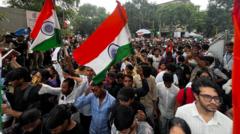

 2 sources
Morning Edition · Monday, July 20, 2026UpdatedPublished at 7:03 AM EDT · New York
Indian Opposition Movement Defies Police Ban With March Toward Parliament
Delhi police refused permission and invoked emergency assembly restrictions, but more than 10,000 people marched toward parliament anyway, and officers used tear gas and batons to stop them.
Updated at 7:03 AM EDT
The banned march went ahead: more than 10,000 people marched in the movement's largest protest yet, police fired tear gas and used batons, and the movement's founder Abhijeet Dipke was detained.
A protest movement marched from the Jantar Mantar monument toward India's parliament on Monday, defying a Delhi police order that refused permission and cited Section 163 of the criminal code, a provision used to restrict public assembly. BBC News Hindi reported that several opposition leaders announced they would join the march despite the ban.
More than 10,000 people took part in what organizers called their largest demonstration yet, and police fired tear gas and used batons to push them back, according to Al Jazeera. The movement said its founder, Abhijeet Dipke, was later detained. The protesters are demanding the resignation of Education Minister Dharmendra Pradhan, an overhaul of the examination system and compensation for the families of students who died after exam paper leaks, grievances sharpened by the forced hospitalization on Saturday of the activist Sonam Wangchuk, who has been on a hunger strike for three weeks.
The movement, described by Deutsche Welle as the Cockroach Janta Party, a name that mocks the ruling party of Prime Minister Narendra Modi, drew a turnout larger than expected. The confrontation pitted organizers determined to march against authorities determined to stop them, though the movement's full size and support remain difficult to verify independently.
The episode fits a recurring pattern of friction between opposition mobilization and the government's use of policing and assembly law. For investors, such confrontations matter less as single events than as a measure of domestic political tension in a market that has drawn heavy foreign inflows on the strength of its stability.
Veracity: Corroborated
79/100- If true, who benefits
Government critics gain visibility from the confrontation, while the state uses assembly law to project order ahead of the parliamentary session.
- The nuance
The ban and Section 163 order are confirmed, but this is a specific activist group over exam-paper-leak grievances rather than a unified opposition movement, and its actual size and support are unverified.
An open-source-intelligence read of how likely this story is true with its real nuance, not a judgment of any outlet. It assesses the claim, weighing independent and adversarial reporting. How we label confidence.
What this means
Recurring clashes between opposition movements and state policing raise the political-risk premium attached to India, because part of the case for Indian assets rests on domestic stability relative to other emerging markets. Foreign portfolio investors are the exposed party, since a perception of rising unrest can slow the inflows that support Indian equities. The channel is sentiment and the stability discount, not any immediate economic disruption.
Synthesized from: BBC News Hindi · Deutsche Welle
Townsquare
Start a discussion in Townsquare.
More from this edition
- Brent Crude Tops 90 Dollars as Iran Strikes Tankers and Hormuz Traffic Slows
- Houthis Declare Immediate Naval Blockade of Saudi Arabia at Bab el-Mandeb, Opening a Second Chokepoint Front
- United States Strikes Iran for Ninth Straight Night as American Death Toll Rises
- Dollar Firms and Gold Holds Near 4,000 Dollars as Oil Shock Revives Higher-for-Longer Bets
- Sensex Falls More Than 600 Points as HDFC and Axis Bank Earnings Disappoint
- Morgan Stanley Becomes Wall Street's Top Arranger of Artificial-Intelligence Debt
- Europe and China Edge Toward a Trade War as a Second Export Shock Builds
Comments
0No comments yet.