← The Global Intelligence Brief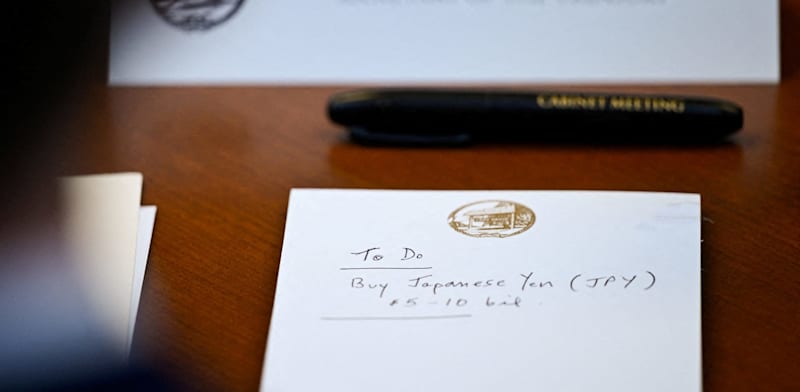


 3 sources
Morning Edition · Sunday, August 2, 2026Published at 1:16 AM EDT · New York
United States Treasury Buys Yen With Japan to Halt a 40-Year Low, Its First Such Intervention in Over a Decade
The New York Federal Reserve sold euros for yen through Goldman Sachs and Morgan Stanley, and the yen rose as much as 3.6 percent before losing most of that gain.
The United States Treasury intervened in the currency market on Friday to buy Japanese yen, joining an operation by Tokyo to halt the yen's steep fall against the dollar. According to Nikkei Asia and CNBC, the Federal Reserve Bank of New York sold euros for yen on the Treasury's behalf through Goldman Sachs and Morgan Stanley, the first coordinated United States-Japan intervention since 2011 and Washington's first yen-buying in more than a decade.
An unusual detail showed the scale. The Israeli financial outlet Globes reported that Scott Bessent, the United States Treasury Secretary, was photographed with a notepad listing a task to purchase between 5 billion and 10 billion dollars of yen, and that Bessent had described the currency as significantly undervalued. The buying pushed the dollar down as much as 3.6 percent against the yen, briefly to about 157.96 yen, before the pair returned toward 160.47, leaving the yen close to the low that had prompted the intervention.
The intervention addresses the effect rather than the cause. The yen is weak because the Bank of Japan has held policy far looser than the Federal Reserve for years, and coordinated buying with borrowed reserves cannot close that difference. Investors seeking protection from currency debasement continued to hold hard assets, with gold near 4,100 dollars an ounce, silver around 58 dollars, and bitcoin near 65,000 dollars.
Veracity: Corroborated
85/100- If true, who benefits
Holders of gold, bitcoin, and dollars, and anyone selling the fiat-fragility thesis the article foregrounds, plus short-term traders positioned for yen strength.
- The nuance
The 5-to-10-billion-dollar scale is inferred from a photographed notepad rather than an official figure, and coordinated buying cannot close the Bank of Japan-Federal Reserve rate gap that drives yen weakness.
An open-source-intelligence read of how likely this story is true with its real nuance, not a judgment of any outlet. It assesses the claim, weighing independent and adversarial reporting. How we label confidence.
What this means
A government that buys its ally's currency is spending finite reserves to counter a trend its own policy divergence created. The exposed parties are holders of Japanese government bonds and the yen carry trade, who face sharp two-way moves if intervention is repeated, Japanese importers who still pay more for dollar-priced energy and food, and United States taxpayers whose reserves now back a foreign exchange rate. If the Bank of Japan does not tighten or the Federal Reserve does not ease, the intervention only delays the pressure rather than setting a durable limit, and that pressure returns.
Synthesized from: Globes (Hebrew) · Nikkei Asia · CNBC
Townsquare
Start a discussion in Townsquare.
More from this edition
- Trump Halts New Strikes on Iran After Gulf States Outline a Deal to Reopen the Strait of Hormuz
- Oil Holds Near 88 Dollars With Hormuz Still Choked and Iranian Crude Smuggling Down 60 Percent
- India's Earnings Week Opens as Brokerages Bet on a Textile Shift Away From China
- Volkswagen Turns to Headhunters to Place Hundreds of Managers It Is Cutting
- Russia Says It Downed 635 Ukrainian Drones Overnight as Strikes Hit Southern Regions
- Bomb at Central Moscow Restaurant Kills Three, Including the Woman Who Carried It
- United States Commander Warns Navy Is Stretched Too Thin to Defend Israel and Its Own Interests
Comments
0No comments yet.