← The Global Intelligence Brief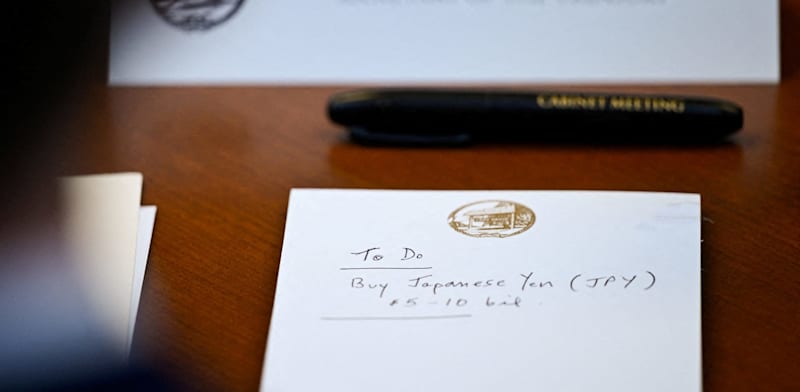


 4 sources
Morning Edition · Sunday, August 2, 2026Published at 1:33 AM EDT · New York
US and Japan Jointly Buy Yen to Halt Its Slide, First Coordinated Intervention Since 2011
The yen strengthened to 157.40 per dollar after the Federal Reserve Bank of New York sold euros for yen on Washington's behalf, days after the currency approached its weakest level against the dollar since 1986.
The United States Treasury bought Japanese yen on Friday, its first yen-buying operation alongside Tokyo in more than a decade, after the currency fell close to its weakest level against the dollar since 1986. The Federal Reserve Bank of New York carried out the purchases by selling euros for yen through Goldman Sachs and Morgan Stanley, acting on the Treasury's instruction.
Israeli financial outlet Globes reported that a photograph of Treasury Secretary Scott Bessent showed a notepad listing an instruction to buy between $5 billion and $10 billion of yen, and that Bessent had called the currency significantly undervalued the previous week. By the close of New York trading on Friday, the yen stood at 157.40 to the dollar, its strongest level since early May, having traded near four-decade lows only two days earlier. Japanese Finance Minister Satsuki Katayama is expected to confirm the joint operation on Monday, the first coordinated action by the two governments since 2011.
The intervention addresses a symptom rather than the cause. The yen's long decline followed years of very loose Bank of Japan policy and a widening gap between Japanese and American interest rates, which drew investment out of the yen and into the dollar. Buying the currency on the open market does not narrow that gap. It signals that the strong dollar has reached a level Washington itself now judges disruptive, even as United States data continues to support expectations that the Federal Reserve will keep policy tight.
Coordinated intervention is a rare tool, used only when officials conclude that a currency has moved beyond what economic fundamentals justify and threatens financial stability. That two of the world's largest economies acted together, rather than Japan acting alone, marks a change in how far authorities will go to manage the consequences of diverging monetary policy.
Veracity: Corroborated
87/100- If true, who benefits
Japanese authorities and import-dependent firms gain a firmer yen, while dollar-funded carry-trade holders face forced unwinding, and Washington signals it no longer welcomes unlimited dollar strength.
- The nuance
The joint operation and the 157.40 level are corroborated across Reuters, Nikkei and others, but the $5-10 billion scale rests on an unverified photograph of a notepad and a Finance Ministry confirmation still only anticipated for Monday.
An open-source-intelligence read of how likely this story is true with its real nuance, not a judgment of any outlet. It assesses the claim, weighing independent and adversarial reporting. How we label confidence.
What this means
A firmer yen raises the cost of the yen-funded carry trade, in which investors borrow cheaply in yen to buy higher-yielding dollar assets, so a sharp reversal can force selling in global equities and bonds as those positions are unwound. Japanese exporters lose the weak-currency advantage that had boosted their earnings. The intervention also signals that the United States no longer welcomes unlimited dollar strength, which limits how aggressively markets can price further Federal Reserve tightening. Investors who treat the dollar as the one dependable reserve currency are reminded that even the officials who manage it will act to weaken it.
Synthesized from: Globes (Hebrew) · Nikkei Asia · CNBC · Korea JoongAng Daily
Townsquare
Start a discussion in Townsquare.
More from this edition
- Trump Halts Fresh Iran Strikes, Citing Gulf-Backed Outline for Reopening Hormuz
- Ukraine Launches Mass Overnight Drone Strikes as Russia Reports 635 Intercepts
- Volkswagen Turns to Headhunters to Place Hundreds of Managers It Is Cutting
- Bomb Kills Three Outside Moscow Restaurant Hosting Military Officers
- Tens of Thousands Cross From Morocco Into Spain's Ceuta, Straining EU Borders
- Brokerage Sees Indian Textile Exporters Gaining as Sourcing Shifts From China
- Israeli Strikes Kill Eight in Gaza Days After Hamas Disarmament Framework
- India Enters Peak Earnings Week With 573 Companies Reporting June-Quarter Results
Comments
0No comments yet.