← The Global Intelligence Brief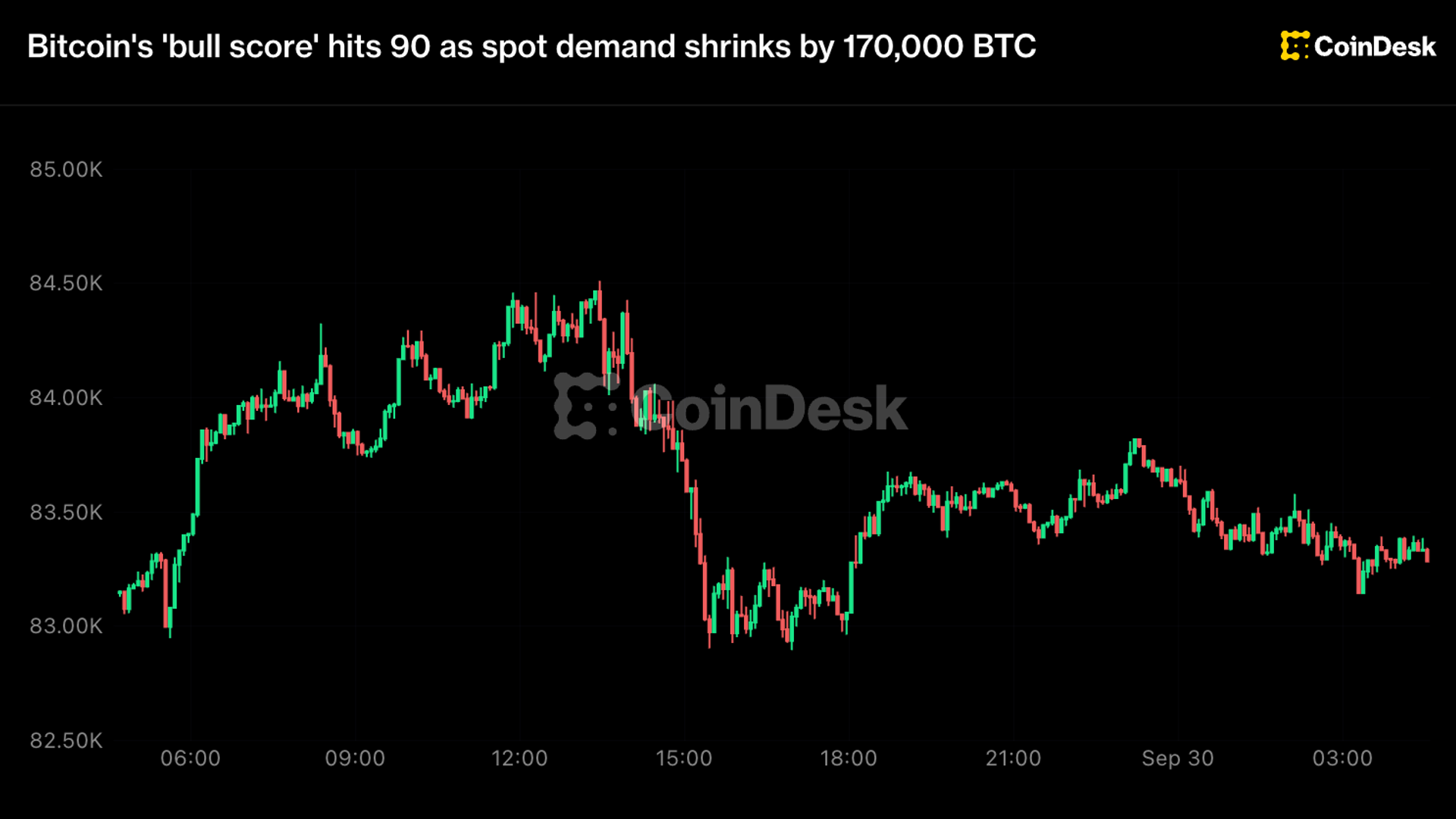

 2 sources
Morning Edition · Wednesday, September 30, 2026Published at 1:25 AM EDT · New York
Bitcoin Slips Back to About $83,600 as the Buyers Behind Its Eight-Month High Retreat
The rally that carried the token above $87,000 on September 21 has faded while gold held near $4,150, repeating the pattern of the past year.
Bitcoin's September advance has stalled. CoinDesk reported that a trend gauge tracked by the onchain analysis firm CryptoQuant is close to its ceiling while the buyers who drove the price to an eight-month high are already pulling back. The high itself was $87,397 on September 21, the strongest level since January, supported by about $715 million of single-day inflows into exchange-traded funds and roughly $750 million of forced short liquidations, according to 247WallSt.
By Tuesday the token had given back most of that move, opening at $83,488 and trading around $83,607 in the afternoon in New York, Fortune reported. Over the same period gold rose about 0.9% to near $4,152 an ounce and silver held around $61.
The divergence is instructive because the macroeconomic news of the day was ambiguous for risk assets and unambiguous for monetary metals. Globes reported that the implied probability of an October Federal Reserve rate increase fell from about 70% to below 50% after a senior official downplayed urgency, while the 30-year Treasury yield touched its highest level since 2002. Bitcoin, which is often described as a hedge against monetary debasement, fell as long-term real borrowing costs rose. Gold, which is bought for the same stated reason, did not.
That split has held through this year's geopolitical shocks, including the war involving Iran and the closure of the Strait of Hormuz. Bitcoin's marginal buyer in 2026 has been the exchange-traded fund flow and the leveraged trader, and both respond to liquidity conditions rather than to the erosion of purchasing power.
Part of a tracked trend
Bitcoin Trades as a Risk Asset, Not Digital Gold
At each geopolitical or inflationary stress point, bitcoin keeps trading with liquidity-sensitive risk assets rather than with monetary metals, so the digital-gold framing continues to fail exactly when investors most want it to hold.
What this means
The mechanism is the composition of the marginal buyer. Bitcoin's price now moves with fund flows and leverage, so rising long-term yields tighten the liquidity that supports it, while gold's marginal buyers include central banks and long-horizon savers who are indifferent to short-term funding costs. The exposed parties are leveraged crypto positions, digital-asset treasury companies that borrowed against holdings, and the exchange-traded products whose inflows set the tone. What is already expected is volatility after a fast rally. What is new is a clean test: a dovish shift in rate expectations did not lift bitcoin while gold rose on the same session. The precedent is the repeated pattern since 2022, when each stress episode saw bitcoin trade with technology equities and gold trade against real rates. The likelier outcome in the coming weeks is that bitcoin keeps tracking equity risk appetite and fund flows rather than gold, so an equity drawdown driven by the long end would take it lower even if the debasement argument gains force. Sustained bitcoin gains during an equity decline would be the evidence that overturns this reading.
What to watch
- Whether exchange-traded fund flows turn negative, since they have been the identifiable source of the September advance.
- Whether bitcoin and gold move in opposite directions again on the next inflation release, the simplest test of which asset is being used as monetary insurance.
- Whether leverage in perpetual futures rebuilds after the September liquidations, because a leveraged base makes the next downward move faster.
Observations to monitor, not financial advice.
Synthesized from: CoinDesk · Globes (Hebrew)
Townsquare
Start a discussion in Townsquare.
More from this edition
- Thirty-Year Treasury Yield Reaches Highest Level Since 2002 as Traders Halve the Odds of an October Fed Hike
- Vanguard Says France Is Degrading Its Credit as Borrowing Costs Climb and Public Workers Strike
- Brent Falls 2.6% to $102.59 as Gulf Exports Recover While the White House Debates a Diesel Export Ban
- US-Led Coalition Formally Ends Its Military Mission in Iraq After Twelve Years
- Trump and AI Company Chiefs Sign a Voluntary Accord to Police Their Own Models
- HSBC Names Its Hong Kong Stablecoin RedCoin for 3.3 Million PayMe Users
- Japan's Industrial Output Falls 1.7% in August as a Kyushu Earthquake and the Iran War Hit Factories
Comments
0No comments yet.