← The Global Intelligence Brief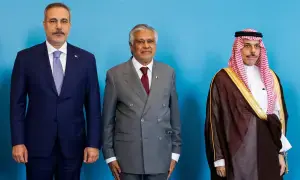


 3 sources
Morning Edition · Monday, October 5, 2026Published at 1:06 AM EDT · New York
Saudi Arabia, Pakistan and Turkey Convene Their Makkah Defence Pact as Yemen's Government Opens an Offensive Against the Houthis
Pakistan sent its foreign minister, army chief and defence minister to the Riyadh meeting, which focuses on Houthi strikes against Saudi infrastructure, including a power facility in Madinah.
Pakistan's Foreign Office confirmed on X that members of the Makkah Joint Defence Agreement will meet in Riyadh on Monday. Pakistan's delegation includes Deputy Prime Minister and Foreign Minister Ishaq Dar, Field Marshal Asim Munir, who is chief of the army and of the defence forces, and Defence Minister Khawaja Asif. Saudi Arabia and Turkey are sending their foreign ministers, defence ministers and chiefs of general staff. Pakistan, Saudi Arabia and Turkey formalized the agreement on August 7 as a framework for collective deterrence.
Pakistani officials say the agenda centers on Saudi Arabia's security situation. The Express Tribune reported that the meeting will assess Houthi attacks on civilian and economic infrastructure, including a recent strike on a power facility in Madinah. The meeting follows an emergency session of the pact's chiefs held last week.
Yemen's internationally recognized government acted the day before the meeting. Rashad al-Alimi, head of Yemen's Presidential Leadership Council, announced military operations to retake all territory held by the Houthis. Al Arabiya reported that al-Alimi said Yemen had moved "from the stage of preparation to the stage of action" and that the operations are not directed at civilians in Sanaa, Hodeidah or Saada. CNN reported that the Saudi-led coalition pledged support. France 24 reported that the Houthis had cut a supply route to the besieged, government-held city of Taiz at the time of the announcement.
Each side describes the fighting differently. Al-Alimi accuses the Houthis of escalating, attacking neighboring countries and threatening shipping lanes. The Houthis present their strikes on Saudi territory as part of the wider war against the United States and its partners. Monday's claims of attacks on Aramco sites in Riyadh and Khurais are the latest example.
Part of a tracked trend
Middle Powers Build Security Blocs Outside Washington
States that once relied on American guarantees keep forming their own mutual defense arrangements, redirecting arms procurement away from Western suppliers and creating overlapping commitments that make regional crises harder to contain.
Veracity: Corroborated
85/100- If true, who benefits
If the pact operates as a real collective defense, Riyadh gains military backing beyond Washington. Pakistan gains Saudi financing and Turkey gains Gulf arms customers, and Yemen's government gains cover for a ground offensive it has long sought.
- The nuance
Asharq Al-Awsat and the coalition's own account of the Taibah station strike in Madinah corroborate the meeting and the attack, which caused an outage but left the grid unaffected. No source shows what the pact will actually commit, and the Houthis describe their strikes as retaliation for Saudi military action, a point government-aligned coverage leaves out.
An open-source-intelligence read of how likely this story is true with its real nuance, not a judgment of any outlet. It assesses the claim, weighing independent and adversarial reporting. How we label confidence.
What this means
Riyadh is organizing its defense through a regional pact that includes Pakistan, a nuclear-armed state with a large army, and Turkey, a NATO member with a large standing military. Riyadh is also backing a Yemeni ground offensive, rather than relying only on American protection. Pakistan offers manpower and deterrent weight and gets Saudi financing. Turkey gains defense-industry customers and influence in the Gulf. Saudi assets, Red Sea shipping and Pakistani sovereign credit are all exposed through this arrangement. The consensus treats the pact as symbolic. The September 2025 Saudi-Pakistan mutual defense agreement was followed within a year by a three-country structure that now holds emergency sessions, which suggests real operational planning. The likelier outcome over the coming months is visible pact support for the Yemeni offensive, such as air defense, advisers or logistics, without Pakistani or Turkish ground troops in Yemen. A formal Pakistani troop deployment into Yemen would prove this wrong and would make Pakistan a party to the war. Expect Houthi strikes on Saudi energy sites to continue while the offensive lasts, which keeps oil risk premiums from falling far.
Synthesized from: Dawn · Investing.com Commodities · The Express Tribune
Townsquare
Start a discussion in Townsquare.
More from this edition
- Flávio Bolsonaro Leads Lula Into Brazil's Runoff, and Brazilian Assets Jump Overnight
- Treasury Yields Hold Near 24-Year Highs After Weak Jobs Data, While the Nikkei Climbs Back Above 70,000
- Brent Falls to About $101.60 as Group of Seven Reserve Releases and Recovering Gulf Exports Outweigh Houthi Claims Against Aramco
- Iran's Security Chief Admits the Economy Is in Its Hardest Period as the Blockade Cuts Oil Revenue
- Reserve Bank of India Expected to Raise Rates for the First Time Since 2023 as Inflation Stays Above Target
- United States Withdraws All 12 B-1 Bombers From Britain's RAF Fairford After a Suspected Plot
- OKX and Intercontinental Exchange Seek SEC Approval to Trade Tokenized Shares of 63 NYSE Companies Around the Clock
Comments
0No comments yet.