← The Global Intelligence Brief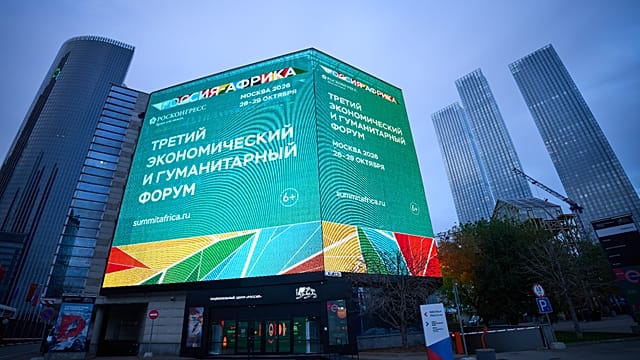


 3 sources
Morning Edition · Tuesday, October 27, 2026Published at 1:06 AM EDT · New York
Moscow hosts gas exporters and 22 African leaders with an agenda on payment systems outside Western banks
The Gas Exporting Countries Forum meets on Tuesday and the Russia-Africa summit follows on October 28 and 29, while Russian clients report new difficulties opening bank accounts in Turkey.
African leaders are gathering in Moscow for meetings on economic ties and energy cooperation. Yuri Ushakov, the Kremlin foreign policy aide, said the eighth summit of the Gas Exporting Countries Forum (GECF) takes place on October 27 and the third Russia-Africa summit on October 28 and 29, according to Vedomosti. The number of attending heads of state has risen to 22 from 17 at the 2023 summit in St. Petersburg. Burundi's president, Évariste Ndayishimiye, the current African Union (AU) chair, will co-chair with Vladimir Putin.
Ushakov said global demand for liquefied natural gas is expected to rise 28% by 2055 and that Russia considers reliable gas supply important. Russian media report that the summit's economic session, titled "Economics of a Sovereign World Order," will focus on an independent payment architecture. Experts quoted there expect decisions on linking Russian payment systems with African platforms.
Kyiv describes a different side of Russia's African policy. Ukraine's state news agency Ukrinform, citing Bloomberg, reports that Russia is widening the range of African countries from which it recruits men for its armed forces to offset losses in Ukraine. Moscow presents the summit as a partnership "for peace, security and development." Both accounts serve their sponsors' interests, and the two activities can happen at the same time.
The need for alternative rails is visible closer to Moscow. RIA Novosti reports that Russian citizens face problems opening accounts in Turkey. Russian outlets report that some Turkish banks refuse Russians under various pretexts, including some customers who hold residence permits, and that others now require high minimum balances. Turkey is a NATO member that has not joined Western sanctions, and its banks still limit their exposure to US secondary sanctions.
Part of a tracked trend
Parallel Payment Rails Outside the Dollar
Sanctioned and non-aligned states keep building payment links outside Western banking, while banks in third countries keep restricting sanctioned clients, so dedollarization advances at the state level more slowly than its advocates claim.
Veracity: Plausible
70/100- If true, who benefits
Moscow gains if attendance turns into payment channels that bypass sanctions. African governments gain bargaining power with Western lenders. If US secondary sanctions keep deterring Turkish banks, the dollar's enforcement system keeps its reach.
- The nuance
TASS confirms the summit dates, but I found the count of 22 heads of state only in Russian sources. Figures on African recruitment and deaths (486 dead by August) come from Ukraine's foreign ministry. Ghana is among the countries that supply recruits, and its president is attending. Reports that Turkish banks refuse Russian clients come only from Russian outlets, and the banks have not explained their policies.
An open-source-intelligence read of how likely this story is true with its real nuance, not a judgment of any outlet. It assesses the claim, weighing independent and adversarial reporting. How we label confidence.
What this means
Moscow is trying to convert diplomatic attendance into financial infrastructure: payment links with African platforms that let trade in energy, grain, arms and fertilizer clear without Western correspondent banks. African governments want discounted energy, security assistance and leverage against Western lenders. Few of them want to lose access to dollar finance, so most will adopt Russian rails alongside existing ones and will not replace them. The Turkish banking problems show the limit of the strategy. Even friendly third-country banks restrict Russian clients when US secondary sanctions threaten their own dollar access. The dollar system's enforcement power therefore remains effective at the bank level while its share of trade settlement erodes slowly at the state level. The precedent is the 2023 summit, which produced grain and debt pledges but little working payment infrastructure. The likelier outcome is a set of signed memorandums on payment-system links this week, with limited transaction volume within a year. Announcements of operational links between Russia's Mir card network or financial messaging system and a large African economy's central bank would show faster progress than that read assumes.
Synthesized from: Africanews · Ukrinform · RIA Novosti
Townsquare
Start a discussion in Townsquare.
More from this edition
- Brazil's Ibovespa falls 13.9% and the real drops 8.2% after Lula wins a fourth term
- Federal Reserve opens a two-day meeting with markets pricing a December rate increase
- Saudi, Pakistani and Turkish security chiefs press Iran on Hormuz after a record month of tanker attacks
- European gas reaches a four-year high as storage runs below normal before winter
- Israelis vote with polls showing neither Netanyahu's bloc nor Eisenkot's bloc reaching a majority
- Pakistan raises its policy rate to 12% as the oil shock reaches central banks and airlines
- Former Bank of Japan governor Kuroda backs more rate increases as services inflation reaches 3.7%
Comments
0No comments yet.