← The Global Intelligence Brief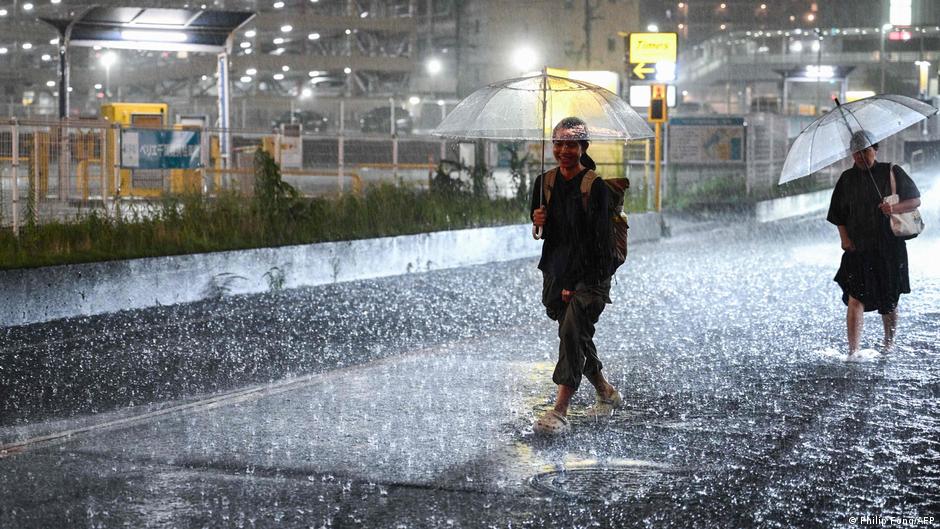

 3 sources
Morning Edition · Friday, August 14, 2026Published at 1:20 AM EDT · New York
Record rain near Tokyo kills four and strands about 7,000 travellers at Narita airport
More than 360 millimetres fell in 24 hours in parts of Chiba prefecture, and forecasters issued the region's highest-level rain warning for the first time.
Rainfall of more than 360 millimetres in 24 hours flooded roads and railways in Chiba prefecture, next to Tokyo, killing at least four people and leaving one missing, the South China Morning Post reported. One of the dead was trapped in a submerged vehicle.
The Japan Meteorological Agency issued its highest-level heavy rain warning for the Chiba region for the first time, Deutsche Welle reported. About 7,000 people were stranded at Narita airport, many sleeping on the floor overnight, and more than 22,000 households were still without power on Friday morning, according to RTE. Soldiers were deployed to assist relief work.
The disruption fell during one of Japan's busiest travel weeks. The South China Morning Post reported separately that Hong Kong tour groups returning from Tokyo were searching for alternative routes to the airport after spending the night on trains and in terminals. Airport authorities said flights were scheduled to operate normally on Friday, but the rail and road links that carry passengers to the terminals were the constraint, not the runways themselves.
Narita handles a large share of Japan's international air cargo alongside its passenger traffic, so the ground-access failure matters beyond stranded holidaymakers. The event is the second significant weather disruption to a major Asian transport hub in recent weeks, and it fits a pattern insurers and infrastructure operators in developed economies have been tracking: drainage and rail systems designed for one rainfall distribution are being tested against another.
What this means
The failure was in surface access rather than in the airport itself, which is the expensive kind of vulnerability because it sits across multiple owners and budgets and no single operator can fix it. Japanese insurers absorb the immediate claims, airlines and freight forwarders absorb rebooking and delay costs, and repeated events of this kind push up the capital that transport operators must commit to drainage and flood defence rather than to capacity.
What to watch
- How quickly rail service to Narita is restored, since prolonged ground-access failure would disrupt air cargo as well as passengers.
- Whether Japanese insurers revise catastrophe loss estimates for the season, which shows whether this is within expected variation or above it.
- Whether the meteorological agency's first use of the top-level warning for Chiba is followed by similar warnings elsewhere this summer, which would indicate a shift in the rainfall distribution rather than a single event.
Observations to monitor, not financial advice.
Synthesized from: South China Morning Post · Deutsche Welle · South China Morning Post
Townsquare
Start a discussion in Townsquare.
More from this edition
- Washington makes cheaper fuel its stated top aim in the Iran war as Treasury threatens total economic isolation
- White House says tariff evasion costs it up to $26 billion a year as Brazil opens a retaliation process
- AI capital spending moves into foreign bond markets as model prices collapse
- Carry traders rebuild yen short positions weeks after the coordinated intervention
- Hong Kong will list the first Shanghai free-trade zone bond as China builds financial channels outside the dollar
- Trump imposes tariffs of up to 100% on imported drones and their components
- Tata Motors profit falls 80% as Gulf shipping disruption reaches Indian corporate earnings
Comments
0No comments yet.