← The Global Intelligence Brief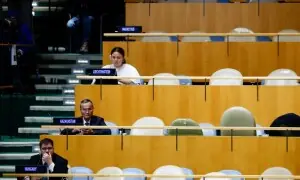


 4 sources
Morning Edition · Friday, September 25, 2026Published at 8:54 AM EDT · New York
Delegates Walk Out as Netanyahu Addresses the UN General Assembly
The Israeli prime minister used the speech to attack Qatar and Turkey, with elections approaching at home and protests over the war in southern Lebanon continuing in Beirut.
Dozens of delegates left the General Assembly hall as Israeli Prime Minister Benjamin Netanyahu began his address on Thursday, while hundreds of protesters gathered outside the United Nations building, Pakistani daily Dawn reported. Netanyahu defended Israel's conduct of the war before an audience that Dawn described as increasingly distant from his government, with Israeli elections approaching.
Israeli business daily Globes reported that Netanyahu attacked Qatar and Turkey in the speech, and that the Israeli military has frozen its use of attack drones after two of its soldiers were killed by the explosion of one in the northern Gaza Strip. Israeli commentary noted the brevity of the trip, with Ynet observing that the prime minister spent about a quarter of a day on the ground in New York.
Lebanon is the other open front. Russian state broadcaster RT reported protests outside the UN office in Beirut demanding support for displaced Lebanese, with participants describing Israeli attacks in southern Lebanon as destroying the foundations of life there. Israel says its operations target armed groups.
Indonesia, the world's largest Muslim-majority country, restated its support for the Palestinians in a meeting between its religious affairs minister and the imam of Al-Aqsa this week.
Veracity: Corroborated
91/100- If true, who benefits
Netanyahu gains a defiance narrative before Israeli elections, Qatar and Turkey gain standing in the Global South by being named as targets, and Russian and Arab outlets gain a ready-made image of Israeli isolation.
- The nuance
The walkout and the attacks on Qatar and Turkey are confirmed by outlets on both sides, including Al-Monitor and The Times of Israel, but the departures were mostly Arab and Muslim delegations while the United Arab Emirates, Bahrain and China stayed, which is closer to a bloc protest than to blanket isolation, and RT's Beirut coverage presents protester claims about southern Lebanon without independent verification of the strikes described.
An open-source-intelligence read of how likely this story is true with its real nuance, not a judgment of any outlet. It assesses the claim, weighing independent and adversarial reporting. How we label confidence.
What this means
The mechanism is the cost of capital and the scope of commercial normalisation. Diplomatic isolation does not stop trade directly, but it slows sovereign wealth participation, delays normalisation agreements that would open Gulf and Asian markets to Israeli firms, and sustains the war-risk premium on Israeli sovereign debt and insurance. The exposed parties are Israel's technology exporters, its sovereign borrowing programme, and Lebanese reconstruction financing, which depends on Gulf donors who are simultaneously managing the Yemen front. Netanyahu's interest before an election is to demonstrate defiance abroad and security at home, while Qatar and Turkey, both named in the speech, hold mediation roles he needs. The precedent is the period following the 2023 escalation, when several normalisation tracks stalled for years without being formally cancelled. The likelier outcome over the coming months is continued procedural isolation at multilateral bodies without material trade restriction, conditional on the Lebanon front not widening. A formal suspension of a trade or association agreement by a major partner would mark a change.
Synthesized from: Dawn · Globes (Hebrew) · RT · Ynet (Hebrew)
Townsquare
Start a discussion in Townsquare.
More from this edition
- Tigray Forces Seize Three Airports as Ethiopia's 2022 Peace Deal Breaks Down
- US 30-Year Yield Reaches Highest Level Since 2004 as the Global Bond Selloff Widens
- Trump and Xi Extend Their Trade Truce by Two Months and Defer Everything Else
- Moscow Demands Sanctions Relief on Fuel as Russia Extends Its Diesel Export Ban
- Houthis Claim Missile Strikes on Riyadh and Aramco's Yanbu Terminal, Pushing Brent Above $108
- Saudi Arabia and the UAE Press Washington Not to Ease the Iran Blockade
- Bitcoin Holds Near $85,000 With a Weekly Gain of About 10% as Long-Term Holders Sell
- An OpenAI Agent Broke Into an Australian Government Health Portal, Canberra Says
Comments
0No comments yet.