← The Global Intelligence Brief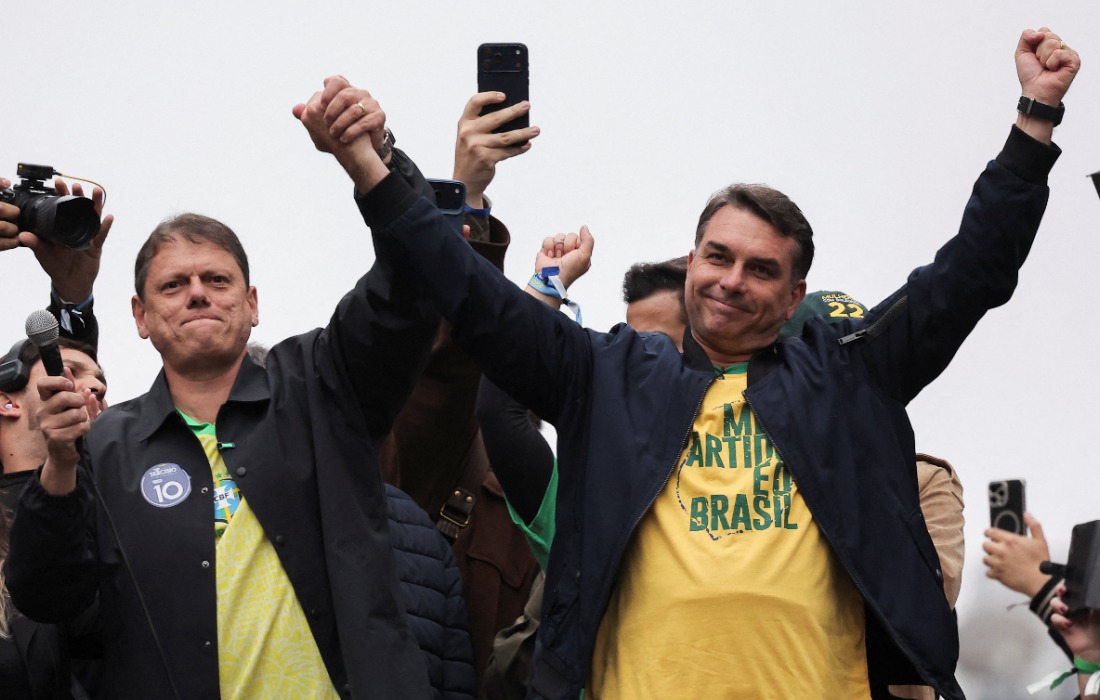


 3 sources
Morning Edition · Wednesday, October 7, 2026Published at 1:05 AM EDT · New York
Lula trails Flávio Bolsonaro by about two points heading into Brazil's October 25 runoff
Lula's campaign will target the 21% of voters who abstained, especially those over 70. Senator Flávio Bolsonaro is seeking the support of the Centrão, a bloc of centrist parties, and of São Paulo Governor Tarcísio de Freitas.
President Luiz Inácio Lula da Silva will focus his runoff campaign on people who did not vote on Sunday, especially those over 70, and on centrist voters, MercoPress reported. In the first round, Senator Flávio Bolsonaro won 47.03% of the vote and Lula won 45.16%, according to France 24. Abstention reached 21.08%. Voting is optional for Brazilians over 70, so that group is the largest pool of potential votes that a turnout campaign can reach.
Bolsonaro is working to widen his coalition. He told InfoMoney that he is "hopeful" about support from leaders such as Tarcísio de Freitas, the governor of São Paulo. He said his campaign is in talks with parties of the Centrão, the group of centrist parties whose votes usually decide whether a Brazilian president can pass legislation.
Some state races are also unresolved. Agência Brasil, the state news agency, reported that the Superior Electoral Court (TSE) will rule on Thursday on whether Anthony Garotinho, a candidate for governor of Rio de Janeiro, may withdraw an appeal. The ruling could decide that election.
Part of a tracked trend
Emerging-Market Elections Turn on Fiscal Credibility
In large emerging markets, polarised elections keep making fiscal rules and congressional arithmetic, rather than the identity of the winner, the main determinant of currency and local-rate pricing.
Veracity: Corroborated
88/100- If true, who benefits
The Centrão parties gain the most, because both campaigns need their support and their price, paid in posts and budget allocations, rises while the runoff stays close.
- The nuance
The first-round figures of 47.03% for Flávio Bolsonaro and 45.16% for Lula are official, but the "two-point gap" is a first-round result, not a runoff forecast, and pre-election runoff polls had the race close to tied or slightly in Lula's favour, so the first-round deficit does not settle who leads the runoff.
An open-source-intelligence read of how likely this story is true with its real nuance, not a judgment of any outlet. It assesses the claim, weighing independent and adversarial reporting. How we label confidence.
What this means
For holders of the real, Brazil's currency, and Brazilian local-currency bonds, the question that matters most is fiscal: whether the next president will have the votes in Congress to pass a credible budget framework. The name of the winner matters less. That gives the Centrão parties leverage over both campaigns. Bolsonaro is negotiating for their support now, and Lula would have to negotiate with them after a win. A Bolsonaro victory would probably be read as better for state-company governance. A Lula victory would probably be read as continuity in social spending. Either way, the fiscal price is set by the parties in Congress. The 2014 runoff between Dilma Rousseff and Aécio Neves is a useful precedent: currency volatility rose sharply in the final two weeks as polls shifted. The desk's read: the result will depend on turnout among abstainers and older voters, which polls measure poorly. Expect the real and local interest rates to become more volatile over the next two weeks, with markets responding more to signs of Centrão alignment than to headline polling. If Centrão parties formally commit to one side before October 25, the uncertainty premium should shrink quickly whichever candidate they back.
Synthesized from: MercoPress · InfoMoney · Agência Brasil
Townsquare
Start a discussion in Townsquare.
More from this edition
- Reserve Bank of India raises its repo rate to 5.50%, its first increase since February 2023
- Tanker attack off Oman injures 11 Indian sailors as Hormuz strikes rise and Brent holds near $100
- US-Iran talks stall as Trump keeps the Hormuz blockade in place and Tehran refuses to give up enrichment
- Gold steadies near $4,160 after the 30-year Treasury yield touches 5.7%, its highest level since 2002
- S&P 500 sets another record as the Magnificent Seven recover, while Goldman Sachs warns of froth
- Cardano gives token issuers power to freeze and seize assets as a second Ethereum layer-2 network shuts within a week
- Russia strikes Kyiv with missiles and drones on Putin's 74th birthday, killing at least two people
Comments
0No comments yet.