← The Global Intelligence Brief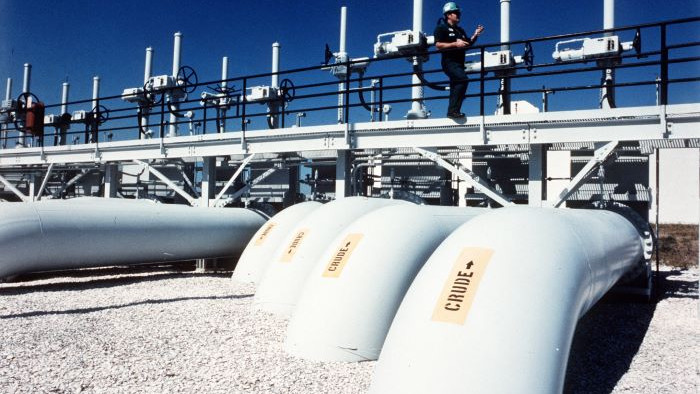


 3 sources
Morning Edition · Saturday, October 24, 2026Published at 1:16 AM EDT · New York
Brent Nears $117 as Washington Lends Crude From a Strategic Reserve at Its Lowest Level Since 1982
The Energy Department released up to 400,000 barrels to a Louisiana refinery on the same day President Trump said the United States "may do another little Epic Fury" against Iran, and US crude closed above $100.
Oil rose for a second day on Friday. Brent crude closed at about $116.91 a barrel, up 3.3% on the session, according to Trading Economics data. Chinese financial press reported a close of $116.72, up 3.1%, and FX168 described the move as a five-month high. West Texas Intermediate, the US benchmark, closed above $100. Investing.com reported that crude was trading near the high it reached during the Iran war, with traders focused on Middle East supply.
The US Department of Energy authorized an emergency exchange of up to 400,000 barrels from the Strategic Petroleum Reserve's West Hackberry site to Phillips 66's Lake Charles refinery in Louisiana, OilPrice reported. The government calls the transfer an exchange, not a sale, and Phillips 66 must return the barrels with additional crude as a premium. According to the same report, the reserve is already at its lowest level since 1982. President Trump drew it down during the war with Iran, and President Joe Biden drew it down after Russia invaded Ukraine.
Three supply problems pushed prices up: attacks on Saudi Arabia, threats to shipping, and reduced output at two Libyan oilfields, according to Trading Economics. At a Florida rally, Trump said the United States "may do another little Epic Fury," using the military's name for its campaign against Iran. He gave no details.
The Israeli business daily Globes linked Friday's losses on Wall Street and in Europe to the rise in oil and to tension in the Middle East. The shock is already showing up in consumer prices. Japan's core inflation rose to 2.1% in September, and Reuters attributed part of that rise to fuel costs from the Middle East conflict.
Washington is now using several tools to hold down fuel prices before the November 3 midterm elections. It lends barrels from a depleted reserve, and it has waived sanctions on Russian diesel. Seen from a sound-money view, both measures delay the price signal rather than add supply. Each barrel lent now is a barrel that will not be available in the next disruption.
Part of a tracked trend
Middle East War Premium Returns to Oil
Renewed US-Iran conflict reinstates a geopolitical risk premium in crude that reverses the earlier de-escalation slide, feeding energy-driven inflation and redistributing income toward oil producers each time brinkmanship flares.
Veracity: Corroborated
82/100- If true, who benefits
Phillips 66 gets crude now and repays it later, oil producers outside the Gulf collect the war premium, and the White House gets slightly lower pump prices before November 3 by using up emergency stock.
- The nuance
Free Malaysia Today confirms the 400,000-barrel exchange, and investingLive confirms the reserve fell to 282.7 million barrels, its lowest since 1982. The stock fell 132.8 million barrels from March 20 under Trump's own Iran-war release, so this small loan did not cause the low level, and the claim that Friday's price rise came from three supply problems belongs to Trading Economics, not to an independent tally.
An open-source-intelligence read of how likely this story is true with its real nuance, not a judgment of any outlet. It assesses the claim, weighing independent and adversarial reporting. How we label confidence.
What this means
The reserve exchange moves barrels from the future into the present. It does not add to supply, and it leaves the United States with less emergency stock at the moment Gulf infrastructure is under attack. Importers with no reserve of their own are the most exposed: Japan, India and European diesel buyers pay through the import bill and through higher inflation. Producers outside the Gulf collect the premium. Markets have largely priced the White House's wish to avoid strikes before the vote. They have priced less of the post-election window, when [The Atlantic reports](https://www.iranintl.com/202610239786) multi-day strikes are under review. The 2022 precedent is relevant. A release of about 180 million barrels eased prices for some months, but it left the reserve at multi-decade lows and limited the response to the next shock. The likelier outcome is that Brent stays near current levels through November 3 and that the risk premium rises after the vote rather than falling. This depends on continued Houthi attacks on Saudi Arabia and no announced round of US-Iran talks. A public US commitment to negotiations, or a return of Iranian or Libyan barrels, would prove this read wrong.
Synthesized from: OilPrice · Globes (Hebrew) · Investing.com Commodities
Townsquare
Start a discussion in Townsquare.
More from this edition
- Washington Reduces Staff at Gulf Embassies as Trump Threatens "Another Little Epic Fury" Against Iran
- Dow Falls 653 Points as Doubts About Artificial-Intelligence Spending Spread Beyond Tech Stocks
- Japan's Core Inflation Rises to 2.1%, Above the Bank of Japan's Target for the First Time in Nine Months
- Brazil Votes Sunday With Lula and Flávio Bolsonaro Tied at 50% in the Final Datafolha Poll
- France Deploys 70,000 Police for Saturday Protests as Its 10-Year Borrowing Cost Reaches 5%
- US Waiver Lets Russian Diesel Back Onto World Markets as Former Executives Say Novatek Secretly Ran an Alaska Gas Project
- Gold Holds Near $4,030 and Bitcoin Near $81,000 as Oil Jumps 3%, While Silver Falls 1%
Comments
1Oct 24, 5:16 AM
With Brent near $117 and WTI just above $100, the spread is roughly $16 to $17, which points to stress concentrated in seaborne Middle East supply rather than in the US inland market.