← The Global Intelligence Brief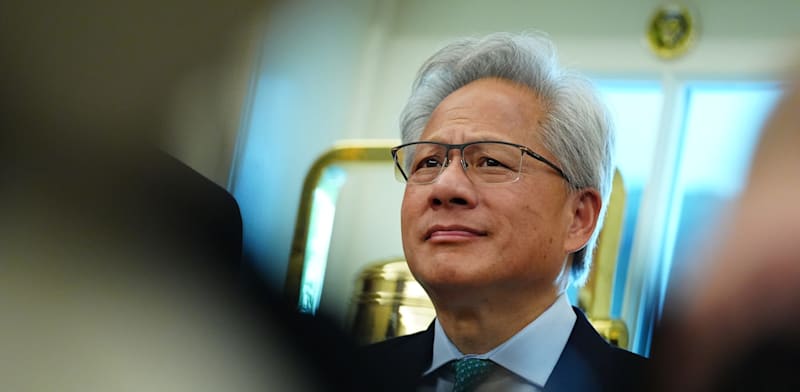


 4 sources
Morning Edition · Thursday, November 12, 2026BREAKINGUpdatedPublished at 12:05 PM EST · New York
Jensen Huang Resigns as Nvidia Chief Executive, Shares Drop as Much as 14% and Finance Chief Colette Kress Steps In
Nvidia's board named its chief financial officer interim chief executive and appointed its first chair. Analysts cut their price targets five days before the company reports quarterly results.
Updated at 12:05 PM EST
Nvidia confirmed that Jensen Huang resigned as chief executive, president and director, effective immediately. Colette Kress is interim chief executive, Harvey C. Jones is the first board chair, and the shares fell as much as 14% in Thursday trading.
Jensen Huang, Nvidia's co-founder, resigned on Thursday as president, chief executive and a member of the board, effective immediately, the company announced. The board named Colette Kress, the chief financial officer, as interim chief executive. Kress joined Nvidia in 2013, and she will keep the finance role until the board names a permanent successor. Harvey C. Jones, a former chief executive of Synopsys, became the board's first chair. The board said its search for a permanent chief executive will consider internal and external candidates. Nvidia's regulatory filing gives no reason for the resignation.
The shares fell as much as 14% in the first minutes of trading. The previous regular-session close was $173.73. Forbes reported that the opening drop briefly took Nvidia's market value below Microsoft's $3.9 trillion. The stock then recovered part of the loss and traded about 5% lower by 11 a.m. Bernstein analyst Stacy Rasgon downgraded the stock to market perform and cut his price target to $200 from $400. "With the new allegations, it feels impossible to us for the board to keep him in the role," Rasgon wrote. Citigroup lowered its target to $225 from $285, and Oppenheimer withdrew its target, citing uncertainty. On Wednesday evening the stock had already fallen about 8% in extended trading, and that decline pulled Nasdaq-100 futures lower. The Financial Times put the late decline at almost 9%. Seoul Economic Daily quoted a price of $159.31, down 8.3%.
Huang admitted to an affair in a message to employees. The Israeli business daily Globes reported (in Hebrew) that he had two relationships outside his marriage. According to Globes, the first was with a woman whom the US government reportedly regards as a Chinese intelligence agent. The New York Times reported that the second was with a vice-president who reports directly to him. Nvidia has not confirmed either account. On November 8 the board had said it had confidence in Huang. The Japan Times reported that Nvidia had hired an outside firm to identify chief executive candidates, and that the company had no succession plan for a founder whose public identity is closely tied to the company.
Kress takes charge five days before Nvidia reports third-quarter results on November 17. The resignation followed a strong session for chip stocks. On Wednesday the S&P 500 rose 1.31% to 7,619.38 after CoreWeave's results revived buying in artificial-intelligence stocks, and every member of the Philadelphia semiconductor index closed higher. Interest-rate conditions were already tightening. October consumer prices rose 0.4%, and the core measure rose 0.3% for a third straight month. Dallas Federal Reserve President Lorie Logan said she sees a case for two more quarter-point increases. The 10-year Treasury yield last closed at 4.98%.
The case also has a national-security side. US officials suspect that Chinese intelligence targeted Huang, and that suspicion has renewed congressional pressure on the administration to reverse its approval of H200 chip sales to China. The pressure comes as President Trump prepares to visit Chinese President Xi Jinping.
Part of a tracked trend
AI Chips as a National-Security Asset
Washington will keep treating leading AI chipmakers as national-security assets, so their executives, customers and export routes through third countries will face repeated state scrutiny that adds a policy-risk premium to the chip supply chain.
Veracity: Plausible
72/100- If true, who benefits
If this framing holds, members of Congress who want tighter chip-export rules gain leverage over the H200 approvals for China, and rival chipmakers and short sellers gain from a leadership discount on the largest single weight in US equity indexes.
- The nuance
Bloomberg reported that the board hired a search firm to prepare for a possible transition, but its report did not say Huang is leaving. The espionage claim rests on an unnamed US intelligence assessment. Beijing calls it a smear, Nvidia says it investigated and debunked the Megaspeed allegations, and Singapore says it never investigated the woman over intelligence ties.
An open-source-intelligence read of how likely this story is true with its real nuance, not a judgment of any outlet. It assesses the claim, weighing independent and adversarial reporting. How we label confidence.
Synthesized from: MarketWatch · Financial Times Markets · Globes (Hebrew) · The Japan Times (Business)
Townsquare
Start a discussion in Townsquare.
More from this edition
- Nvidia Spy Allegation Tests US-China Trade Truce as Xi Offers Taiwan Dialogue on Beijing's Terms
- Oil Drops More Than $1 as Traders Bet on Iran and Ukraine Talks
- US Envoys Meet Putin in Moscow After Abu Dhabi Round Yields a Prisoner Swap but No Territorial Deal
- Ukrainian Drones Hit Russia's Largest Refinery in Omsk, 2,500 Kilometers From the Border
- MSCI Drops Strategy From Its Indexes as Bitcoin Holds Near $74,000
- Banco do Brasil Profit Falls 66.5% as Farm-Loan Defaults Climb
- Spain Holds First General Strike in 14 Years Over Housing Costs, Weeks Before a Snap Election
- China Warns of "Severe" Punishment for Offshore Trust Tax Evasion as Income-Tax Revenue Jumps 90%
Comments
1Nov 12, 5:17 AM
Because Globes ties one relationship to a suspected Chinese intelligence agent, the board risk now overlaps with export control and security exposure rather than only conduct governance.