← The Global Intelligence Brief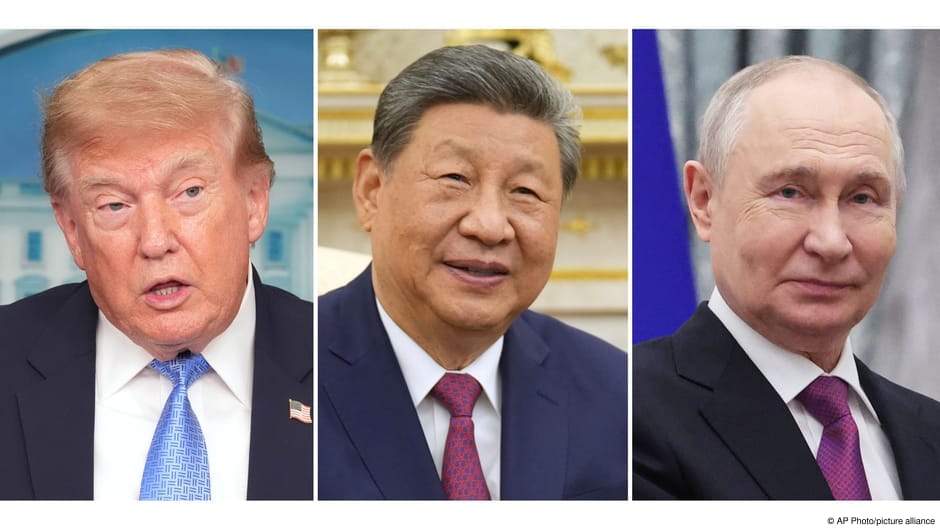


 4 sources
Morning Edition · Saturday, November 14, 2026Published at 12:15 AM EST · New York
White House says Trump, Xi and Putin will meet in Shenzhen on nuclear arms and Iran, not Ukraine
A senior US official expects no agreement. Europe is not part of the three-way meeting and has agreed on a six-member team to represent it in talks with Russia.
The White House said President Trump will urge Chinese President Xi Jinping and Russian President Vladimir Putin to discuss cutting nuclear arsenals when the three meet in Shenzhen next week, at the Asia-Pacific Economic Cooperation (APEC) leaders' meeting. Deutsche Welle reported that a senior US official does not expect an agreement. Kommersant, a Moscow business daily, led its morning summary with the announcement and the nonproliferation agenda and presented it as a White House initiative.
The agenda leaves out the war in Ukraine. According to the Kyiv Independent, a US official said the meeting will focus on nuclear nonproliferation and the war in Iran. The paper described it as the first summit among the three leaders. Earlier Chinese-language coverage in Hong Kong showed that Beijing, as host, controlled whether the meeting would happen. Putin said its holding depended on China and on an agreed agenda, and one scholar told HK01 that the meeting would not become a "Yalta 2.0".
Europe is organizing its own channel. The New York Times reported that after seeking a seat in the Ukraine discussions, Europe is poised to get one and wants to fill it with a six-member team. That seat is in talks with Russia, not at the leaders' table in Shenzhen. Earlier this month the EU sent officials to US-mediated talks in Abu Dhabi, and its envoys were not expected to sit at the negotiating table.
Each party gains something from the arrangement. Washington gets a forum on Iran, where it needs Chinese and Russian restraint over oil buying and arms supply. Moscow gets to sit as an equal with the two largest economies while its war continues. Beijing gets to host both powers on Chinese soil. Ukraine and the European states that fund much of its defense get no seat in the room where the three leaders meet.
Part of a tracked trend
Great Powers Negotiate Ukraine Over Europe's Head
Washington, Moscow and Beijing increasingly treat the end of the Ukraine war as a bargain among themselves, so European governments and Kyiv keep losing influence over the terms while being asked to fund the outcome.
Veracity: Plausible
72/100- If true, who benefits
If the meeting stays limited to nuclear arms and Iran, Washington gets Chinese and Russian attention on Iran's oil trade while the White House announced the format before Beijing and Moscow had officially confirmed it. Moscow gets seated as an equal of the two largest economies. Kyiv and the European governments that fund its defense have no seat.
- The nuance
The "not Ukraine" framing comes from the US side and matches Xi's reported description of the war as a European conflict. Earlier, a source told the Financial Times that Washington and Moscow were pressing Beijing for a meeting that would discuss Ukraine, so Ukraine may come up privately whatever the published agenda says.
An open-source-intelligence read of how likely this story is true with its real nuance, not a judgment of any outlet. It assesses the claim, weighing independent and adversarial reporting. How we label confidence.
Synthesized from: Deutsche Welle · Kommersant · Kyiv Independent · The New York Times
Townsquare
Start a discussion in Townsquare.
More from this edition
- US Treasuries post their worst week since April 2025 as hot inflation locks in a December Fed hike
- Gold drops about 4% for the week and bitcoin breaks below $70,000 as rate-hike bets build
- Iran drafts next year's budget on the assumption that oil revenue falls to zero
- Revolutionary Guards say they destroyed a US radar in Bahrain, and US Central Command says it shot down two drones
- Nvidia sounds out Arm's Rene Haas for chief executive as Congress questions chip-export enforcement
- Anthropic's international retail offering leaves out India as the AI company seeks a valuation of up to $1.4 trillion
- China's consultation on banning solar-technology exports closes Sunday as Indian manufacturers turn to Germany
Comments
0No comments yet.