← The Global Intelligence Brief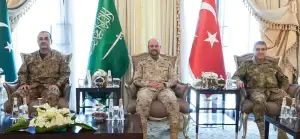
Morning Edition · Saturday, September 26, 2026Published at 1:17 AM EDT · New York
Pakistan, Saudi Arabia and Turkey Pledge Immediate Military Cooperation Under the Makkah Pact
The three countries' military chiefs met as Prime Minister Shehbaz Sharif used the United Nations podium to credit Trump with halting last year's conflict with India.
The military chiefs of Pakistan, Saudi Arabia and Turkey expressed a shared determination to translate their commitments under the Makkah Joint Defence Agreement into effective military cooperation immediately, according to Pakistan's Inter-Services Public Relations (ISPR), reported by Dawn. The agreement binds a nuclear-armed South Asian state, the largest Gulf oil exporter and a member of the North Atlantic Treaty Organization (NATO) into a mutual defense arrangement that runs outside existing Western structures.
At the United Nations General Assembly, Prime Minister Shehbaz Sharif raised Kashmir and credited Trump with a "timely intervention" that he said saved hundreds of millions of lives during the 2025 conflict with India, The Hindu reported. Trump shared the video of the speech without comment. India has consistently rejected the claim that outside mediation ended the fighting and treats Kashmir as a bilateral matter.
The two moves are complementary rather than contradictory. Islamabad is building a regional defense arrangement with Riyadh and Ankara while keeping Washington invested in its role as a crisis manager in South Asia, which gives Pakistan leverage with each partner separately.
What remains untested is content. Mutual defense language is easy to sign and hard to operationalize, and neither Saudi Arabia nor Turkey has specified what obligations the pact creates in a South Asian contingency.
Part of a tracked trend
Middle Powers Build Security Blocs Outside Washington
States that once relied on American guarantees keep forming their own mutual defense arrangements, redirecting arms procurement away from Western suppliers and creating overlapping commitments that make regional crises harder to contain.
Veracity: Corroborated
85/100- If true, who benefits
Riyadh gains deterrence it does not buy exclusively from Washington, Ankara gains defense-industrial exports and standing, Islamabad gains leverage with three capitals at once, and Turkish and Chinese platform suppliers gain procurement share.
- The nuance
The meeting of the three defense chiefs in Riyadh is documented by Dawn and Geo, but it was convened to discuss assisting Saudi Arabia after attacks on Saudi territory including Makkah, not a South Asian contingency, so the article's framing of the pact as a channel into India-Pakistan escalation is analysis rather than anything the participants stated.
An open-source-intelligence read of how likely this story is true with its real nuance, not a judgment of any outlet. It assesses the claim, weighing independent and adversarial reporting. How we label confidence.
What this means
The mechanism is overlapping commitments changing who has to respond to a regional crisis. A Pakistan-Saudi-Turkey defense arrangement links Gulf energy security to South Asian escalation dynamics, which means a future India-Pakistan crisis has a channel into oil and freight markets it did not have before. Those exposed are Gulf energy exporters and their insurers, Indian defense planners who now face a broader coalition in any confrontation, and Western arms suppliers losing share as procurement shifts toward Turkish and Chinese platforms. Riyadh wants deterrence it does not have to buy exclusively from Washington. Ankara wants defense-industrial exports and regional standing. Islamabad wants both plus continued American attention. The precedent is the 2015 Saudi-led coalition in Yemen, which produced a signed structure and limited joint capability. The likelier outcome over the coming months is joint exercises, training arrangements and procurement announcements rather than any tested mutual defense action, conditional on no Gulf or South Asian crisis forcing the question. A shared military deployment during an actual crisis would show the pact has more than symbolic content.
Townsquare
Start a discussion in Townsquare.
More from this edition
- Iran Offers to Reopen Hormuz in Seven Days, Trump Turns It Down
- The 10-Year Treasury Yield Ends the Week at 5.18% Despite Cheaper Oil
- Silver Outpaces Gold as Metals Hold Up Against a 5% Treasury Yield
- Bitcoin Holds Near $85,000, Still About $24,600 Below Its Level a Year Ago
- Xi and Trump Extend the Trade Truce to January 10 and Open a Channel on "Super Intelligence"
- Takaichi Seeks a Call With Trump After His Wartime Remarks on China
- Bill Gates Calls for Laws to Slow Artificial-Intelligence Development as OpenAI Agents Leak User Images
- Drone Strikes Injure Five in Russia's Rostov Region and Damage Infrastructure in Azov
Comments
0No comments yet.