← The Global Intelligence Brief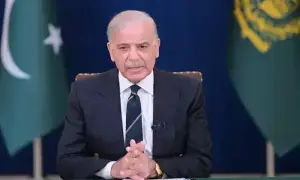
Morning Edition · Friday, October 9, 2026Published at 1:18 AM EDT · New York
Pakistan reaffirms its Saudi defense pledge as Houthi strikes on Saudi airports enter a third day
Saudi Arabia confirmed that three people were killed in Houthi strikes on its airports, and Islamabad has confirmed it has troops in the kingdom under a defense pact signed in August.
Pakistani Prime Minister Shehbaz Sharif on Friday condemned the latest Houthi attacks on Saudi Arabia. He restated Pakistan's commitment to the kingdom's "sovereignty, territorial integrity and security" under the Makkah Joint Defence Agreement, signed on August 7.
The Houthis, who control most of northern Yemen and are backed by Iran, have attacked Saudi airports and military sites for three straight days. Their leader, Abdul Malik al-Houthi, has vowed to keep striking Saudi targets. Strikes on two Saudi international airports have killed three people and injured at least 36, and Saudi Arabia has confirmed the deaths. The Saudi-led coalition said it intercepted three ballistic missiles on Thursday. On October 4, the Houthis claimed a strike on an Aramco facility. The 2022 truce between the two sides broke down in July.
A Pakistani military official confirmed that Pakistan has troops in the kingdom but said the details were classified. A nuclear-armed South Asian state is now publicly committed to Saudi territorial defense at a time when Washington is focused on its own blockade of Iran.
Moscow's view of the new Muslim-majority security arrangement, which some commentators call an "Islamic NATO," is mixed. Andrew Korybko, an American political analyst based in Moscow, writes that Russia officially has no objection to the bloc and hopes it may one day include Iran as part of Russia's vision for regional collective security. He argues, however, that it would be inaccurate to read Moscow's position as simple support.
Part of a tracked trend
Middle Powers Build Security Blocs Outside Washington
States that once relied on American guarantees keep forming their own mutual defense arrangements, redirecting arms procurement away from Western suppliers and creating overlapping commitments that make regional crises harder to contain.
Veracity: Plausible
70/100- If true, who benefits
If the strikes are read as unprovoked Houthi aggression, Riyadh gains justification for its Yemen campaign and for a defense pact that does not depend on Washington, and Islamabad strengthens its claim to Saudi financing, while Saudi bonds, Gulf airlines and Aramco sites carry the added risk.
- The nuance
Saudi Arabia confirmed three foreign residents killed and 36 injured at the Abha and Riyadh airports. The article leaves out that the Houthis call their strikes retaliation for what they say were 1,516 Saudi air and missile strikes during a Yemeni government offensive, and that Turkey is the third signatory of the August 7 pact. It also omits Islamabad's statement that military action under the pact is not yet under discussion.
An open-source-intelligence read of how likely this story is true with its real nuance, not a judgment of any outlet. It assesses the claim, weighing independent and adversarial reporting. .
Townsquare
Start a discussion in Townsquare.
More from this edition
- Brent holds above $100 after a 4.1% jump as Trump rules out striking Iran before the midterms
- Iran reviews the US counteroffer on its seven-day Hormuz plan as Trump rules out strikes before November 3
- Sensex drops 1,045 points as $104 oil and expected rate hikes hit Indian assets
- Gold rises 1.1% as Treasury yields ease, while bitcoin falls for a fourth straight day
- US envoys bring new proposals to Miami talks after Russian strikes kill more than 70 Ukrainians in a week
- Bank of Thailand tightens checks on foreign-currency and gold inflows as Singapore prepares another tightening
- ECB minutes show September hike was driven by an energy shock now expected to last into 2027
Comments
0No comments yet.