← The Global Intelligence Brief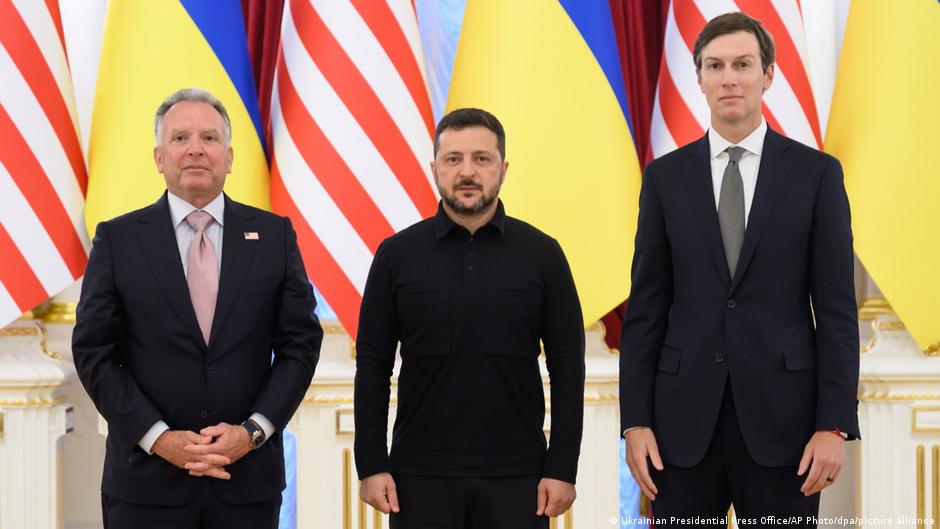


 4 sources
Morning Edition · Friday, October 9, 2026Published at 1:18 AM EDT · New York
US envoys bring new proposals to Miami talks after Russian strikes kill more than 70 Ukrainians in a week
One proposal is a partial ceasefire covering energy infrastructure and grain shipments, which Kyiv has said it would accept and Moscow has so far resisted, while Ukrainian drones injured nine people in Russia's Kaluga region overnight.
Officials from Ukraine, Europe and the United States are meeting in Miami to try to break the deadlock in the war. Russian strikes on Ukraine killed more than 70 people this week. Steve Witkoff and Jared Kushner, President Trump's envoys, plan to present what Axios called "new ideas and proposals". The talks are expected to last two days and to cover security guarantees and a post-war economic plan. Washington also invited national security advisers from Britain, France and Germany, together with North Atlantic Treaty Organization (NATO) and European Union officials. Russia is not taking part.
One proposal is a partial ceasefire that would stop attacks on energy infrastructure and grain shipments. Ukraine has said it would accept such a step, and Russia has shown little interest. Strikes on energy infrastructure continued while the parties prepared for the meeting. On October 8, more than 3 million Kyiv residents lost power after a Russian attack on an energy facility, and Britain announced a $71 million winter aid package.
Strikes also continued inside Russia. The governor of the Kaluga region said nine people were injured, five of them hospitalized, after drone attacks overnight. He said air defenses shot down 26 drones over the region, including over the city of Kaluga.
Money matters as much as the talks. Russian state news agency TASS reported that Ukraine needs an additional $67 billion to pay for military spending in 2027, against its own revenues of $71.7 billion. Moscow's state media present the figure as proof that Kyiv depends on Western money. For Ukraine's backers, it is the size of the bill they would have to cover if the war continues into 2027.
Part of a tracked trend
Strikes Move to Each Other's Home Fronts
Both Russia and Ukraine keep shifting long-range strikes toward transport, warehousing and civilian-adjacent targets far from the front, so aviation, logistics and insurance costs deep inside both economies keep rising and each mass-casualty incident pushes a negotiated pause further away.
Veracity: Plausible
74/100- If true, who benefits
If Moscow alone is blocking an energy truce, Kyiv can press European governments for more money and air defense, Moscow keeps the winter grid strikes that, according to sources familiar with the Kremlin's position, President Vladimir Putin sees as a way to force concessions, and European budgets carry Ukraine's 2027 funding gap.
- The nuance
The Miami agenda and the partial-ceasefire proposal and the October 8 Kyiv outage are corroborated. The article does not say that a US energy truce would also halt Ukraine's drone strikes on Russian refineries, or that Trump announced such a truce in September before Moscow had agreed to any deal. The Kaluga casualty count comes only from a Russian Telegram channel quoting the governor, and this desk did not check TASS's $67 billion figure against Ukrainian Finance Ministry data.
An open-source-intelligence read of how likely this story is true with its real nuance, not a judgment of any outlet. It assesses the claim, weighing independent and adversarial reporting. .
Synthesized from: Deutsche Welle · Kyiv Independent · TASS · Polylog editors
Townsquare
Start a discussion in Townsquare.
More from this edition
- Brent holds above $100 after a 4.1% jump as Trump rules out striking Iran before the midterms
- Iran reviews the US counteroffer on its seven-day Hormuz plan as Trump rules out strikes before November 3
- Sensex drops 1,045 points as $104 oil and expected rate hikes hit Indian assets
- Gold rises 1.1% as Treasury yields ease, while bitcoin falls for a fourth straight day
- Bank of Thailand tightens checks on foreign-currency and gold inflows as Singapore prepares another tightening
- Pakistan reaffirms its Saudi defense pledge as Houthi strikes on Saudi airports enter a third day
- ECB minutes show September hike was driven by an energy shock now expected to last into 2027
Comments
0No comments yet.