← The Global Intelligence Brief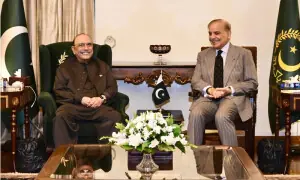
 2 sources
Morning Edition · Sunday, October 11, 2026UpdatedPublished at 7:34 AM EDT · New York
Pakistan's Government Weighs Emergency Rule in Khyber Pakhtunkhwa as Its Feud With Imran Khan's Party Deepens
President Asif Ali Zardari approved emergency rule and governor's rule in Khyber Pakhtunkhwa on Sunday, dissolving the province's Pakistan Tehreek-e-Insaf government, after the federal cabinet recommended the move and police had already put districts on alert for violent protests.
Updated at 7:34 AM EDT
The emergency that Islamabad was "weighing" this morning was declared and signed into effect Sunday, dissolving the PTI-led provincial government.
Pakistan's federal government imposed emergency rule in Khyber Pakhtunkhwa (KP) on Sunday, ending the provincial government led by the party of jailed former prime minister Imran Khan. Prime Minister Shehbaz Sharif's cabinet met Sunday and recommended the measure, and President Asif Ali Zardari signed the summary invoking Articles 232 and 234 of the constitution, which govern emergency rule and a governor's administration of a province. PropPakistani reported that power in the province now shifts to the governor, and ThePrint said the provincial government led by Pakistan Tehreek-e-Insaf (PTI) has ceased to exist as a result.
The federal government's stated rationale is a surge in militant violence. An intelligence assessment cited by local outlets found that terrorist incidents in KP rose 195% between March 2024 and September 2026. The presidential declaration pointed to rising attacks on government installations, infrastructure and law enforcement, and federal ministers had already accused the PTI provincial administration, led by Chief Minister Sohail Afridi, of refusing to cooperate with the center.
Ahead of the decision, KP's police chief, Inspector General Zulfiqar Hameed, had put district police on alert for violent protests and sabotage, and told commanders to use caution in any use of force. Maulana Fazlur Rehman, a senior opposition cleric, had spent the preceding days meeting both Sharif and PTI leaders in an unsuccessful effort to head off the move. The PTI has said its campaign, including an Oct. 4 march on Islamabad, aims to win the release of Khan, and the party is expected to contest the emergency as an attempt to strip it of its one governing province.
The crisis unfolds as Islamabad takes on commitments abroad. Days earlier, Sharif restated Pakistan's defense commitment to Saudi Arabia after the Houthi strike on Riyadh's main airport.
Part of a tracked trend
Pakistan's Strategic Overextension
Pakistan keeps taking on external security commitments, from the Saudi defense pact to its western border, while its domestic political conflict deepens, so recurring internal crises will keep testing its capacity to honor those commitments and raising its sovereign risk.
Veracity: Plausible
68/100- If true, who benefits
If the federal framing holds (that the province failed to control militancy), the governing Pakistan Muslim League-Nawaz (PML-N) and Pakistan Peoples Party (PPP) coalition gains a constitutional route to remove the provincial government of Pakistan Tehreek-e-Insaf (PTI) in the party's strongest province. The army gains more direct control over counterterrorism along the Afghan border.
- The nuance
The Express Tribune and ARY News confirm that the government is considering an emergency. ARY, citing unnamed sources, also reported that Maulana Fazlur Rehman advised against emergency or governor's rule and that the government decided to give his mediation time. A "finalized plan" is therefore not yet a decision. The PTI rejects the terrorism rationale and says it is being targeted for its campaign to free Imran Khan.
An open-source-intelligence read of how likely this story is true with its real nuance, not a judgment of any outlet. It assesses the claim, weighing independent and adversarial reporting. .
Synthesized from: Dawn (emergency) · Dawn (police alert)
Townsquare
Start a discussion in Townsquare.
More from this edition
- Washington Suspends Russian Diesel Sanctions Until April Under a Trump-Putin Supply Deal
- US Long-Term Yields Stay Near Two-Decade Highs as Pre-Election Spending Adds to Fiscal Worries
- Supertanker Rates Topped $1 Million a Day as the Iran War Lengthened Oil Voyages
- Houthi Strike on Riyadh's Main Airport Kills 12 and Wounds 309
- Gold Rises 1.8% to About $4,183 While Bitcoin Slips Toward $82,800
- Indian Economists Expect the Reserve Bank to Raise Rates by Up to a Full Percentage Point as Oil Keeps Inflation Up
- Drone Strikes Shut a Third Yandex Data Center, Disrupting Russian Taxi, Delivery and Cloud Services
Comments
0No comments yet.