← The Global Intelligence Brief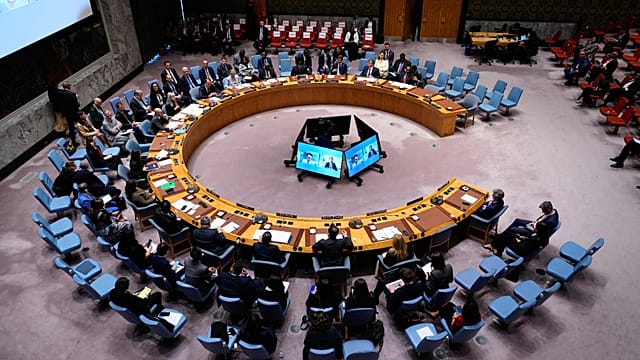

 3 sources
Morning Edition · Sunday, October 18, 2026Published at 1:07 AM EDT · New York
Every candidate to lead the United Nations drew a permanent-member veto in the latest Security Council poll
Former Senegalese President Macky Sall withdrew the next day, leaving the council without a consensus choice for a term that starts January 1.
All seven candidates to succeed António Guterres as United Nations secretary-general received a "discourage" vote from a permanent Security Council member in the latest informal straw poll, a diplomat told Africanews on Friday. A "discourage" from one of the five permanent members amounts to a veto. The poll used color-coded ballots, which separate the votes of the five permanent members from those of the ten elected members but do not show how each country voted.
A day later, Macky Sall, the former president of Senegal, withdrew from the race. Carolyn Rodrigues-Birkett, Guyana's ambassador to the United Nations, had been considered one of the strongest candidates. She warned that failing to choose a woman would send "a very negative message to the world".
The earlier rounds had already shown no clear favorite. In the October 7 poll, Costa Rica's Rebeca Grynspan kept the lead with nine "encourage" votes, but six members opposed her, twice as many as before. Argentina's Rafael Grossi, head of the International Atomic Energy Agency, moved into second place.
Part of a tracked trend
Multilateral Institutions Stall Under Great-Power Vetoes
As the United States, China and Russia use their vetoes against each other's preferences, global institutions keep failing to fill leadership posts or act on crises, so states turn to bilateral deals and regional groupings to manage conflicts that move markets.
Veracity: Corroborated
83/100- If true, who benefits
The permanent members gain room to trade the post for concessions elsewhere, and Latin American and Caribbean candidates gain from Sall's exit, since he said the straw polls favor that region and possibly a woman.
- The nuance
The anonymous ballots do not show who blocked whom, and US media reports that Washington opposes all seven contenders would make the deadlock mainly a US objection rather than the three-way split among Washington, Beijing and Moscow that the edition infers.
An open-source-intelligence read of how likely this story is true with its real nuance, not a judgment of any outlet. It assesses the claim, weighing independent and adversarial reporting. How we label confidence.
What this means
The secretary-general has little enforcement power, but the office does run mediation channels that matter in the Gulf and Ukraine wars. For markets, the vetoes matter mainly as a measure of great-power division. If the five permanent members cannot agree on a leader, they will not agree on a Security Council mandate for Hormuz shipping or a Ukraine ceasefire. The United States, China and Russia each appear to be blocking candidates they see as tied to rivals, though the ballots do not show who blocked whom. The precedent is 2016. The council switched to color-coded ballots in its sixth poll and nominated Guterres the next day, because the permanent members had already agreed privately. This time the color-coded poll produced a veto against every candidate, which shows no such private agreement exists yet. The likelier outcome is a late compromise candidate, possibly one not yet in the race, chosen in November or December. This depends on the permanent members trading the post for concessions elsewhere. The read would be wrong if one current candidate clears the next color-coded poll with no permanent-member veto.
Synthesized from: Africanews · Africanews · MercoPress
Townsquare
Start a discussion in Townsquare.
More from this edition
- Trump suspends Russia oil tariffs for 60 days as Brent crude nears $110
- Tankers hit near Hormuz as Trump rejects Iran's terms for reopening the strait
- US interest bill tops $1 trillion as hotter inflation revives Federal Reserve hike bets
- Credit markets turn against AI builders as CoreWeave bond yields approach 15%
- Ukrainian drones set fire to a St. Petersburg oil terminal as Russian strikes halt a car-parts plant in Lutsk
- France arrests 1,200 as cost-of-living protests turn to looting and arson
- Flávio Bolsonaro leads Lula 51% to 49% in Datafolha poll a week before Brazil's runoff
Comments
0No comments yet.