← The Global Intelligence Brief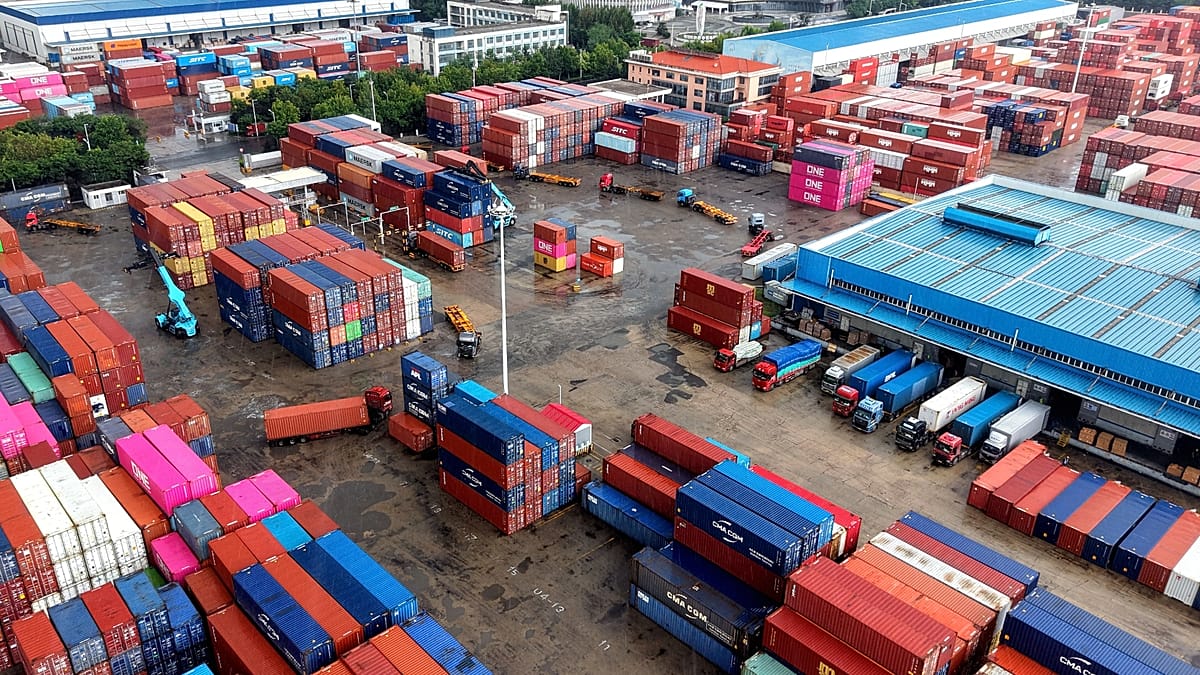


 3 sources
Morning Edition · Monday, October 19, 2026Published at 1:11 AM EDT · New York
China's economy grew 4.5% in the third quarter as exports surged and retail sales barely rose
September exports jumped 36.3% from a year earlier, led by a 136% rise in integrated-circuit shipments, while property investment fell 20.6% in the first nine months.
China's gross domestic product (GDP) grew 4.5% from a year earlier in the July to September quarter, according to official figures released on Monday. That is up from 4.3% in the second quarter, a pace Euronews described as the slowest in more than three years. The result beat the 4.4% median forecast in a Reuters poll. Japan's Jiji Press reported that the figure sits at the lower bound of the government's growth target.
Foreign demand produced almost all of the gain. September exports reached $447.18 billion, up 36.3% year on year, against the 25.5% economists expected. Integrated-circuit exports alone rose 136% to $45 billion. The Financial Times summarized the result as strong exports offsetting lagging domestic demand.
Domestic figures were weak. Retail sales rose 1.1% in September, and industrial output grew 5.5%, according to CNBC's account of the data. In the first nine months, fixed-asset investment fell 7.2%, infrastructure investment fell 4.2%, and property investment fell 20.6%.
The figures describe two separate economies. One is a factory sector that the state's credit system keeps funding and that sells its output abroad. The other is a household and property sector still working off a decade of debt-financed overbuilding. The property contraction is the slow unwinding of that earlier boom. Beijing has chosen to absorb it through exports rather than through transfers to households. The chip-export surge also matters for the broader US-China technology competition: it shows Chinese semiconductor capacity reaching foreign buyers in volume despite United States export controls.
Part of a tracked trend
China Exports Its Way Around a Domestic Slump
China keeps meeting its growth targets by pushing factory output into foreign markets while household demand and property stay weak, so each quarter of export-led growth adds to trade friction and lowers manufactured-goods prices for its trading partners.
What this means
Growth that depends on exports sends China's surplus manufacturing capacity into the rest of the world as lower prices for manufactured goods. Manufacturers in Europe, South Korea, Mexico and Southeast Asia that compete with Chinese products lose margin. Trade-defense measures become more likely. Commodity exporters gain only where Chinese factory output raises demand for their inputs. Markets priced the beat on Monday as good news for risk assets. The consensus may be wrong to read it as a recovery, because a 1.1% rise in retail sales and a 20.6% fall in property investment show household demand is not filling the gap. The likelier outcome is that Beijing holds off on large transfers to consumers while exports carry growth. If so, expect more anti-dumping and safeguard cases from the European Union and from emerging economies within months, and continued complaints in Washington about Chinese chip and electronics volumes. This depends on export growth staying well above domestic demand in the fourth quarter. The desk's read is wrong if Beijing announces direct household income support at the year-end economic meetings, or if export growth falls back sharply.
What to watch
- China's October export data. A sharp slowdown from September's 36% pace would show the surge was front-loading ahead of trade restrictions, not lasting demand.
- The tone of China's year-end Central Economic Work Conference on household consumption. Concrete transfers to households would show Beijing shifting away from growth driven by investment and exports.
- New European Union trade-defense cases against Chinese electronics and machinery. Each new case raises costs for European importers and for the Chinese exporters that supply them.
Observations to monitor, not financial advice.
Synthesized from: Jiji Press · Euronews · Financial Times
Townsquare
Start a discussion in Townsquare.
More from this edition
- Trump waives Graham Act sanctions on Russian energy, and Brent falls toward $108
- Gold trades near $4,180 and silver near $58 after Warsh lowers expectations of an October Fed hike
- Putin proposes a summit with Trump and Xi in Shenzhen to negotiate an end to the Ukraine war
- Iran says its seven-day plan to reopen the Strait of Hormuz is still on the table
- Takaichi declines to rule out new government bonds to pay for Japan's food tax cut
- Ukraine hits a St. Petersburg oil terminal in a raid Russia says involved more than 1,000 drones
- Bank of England examines whether Barclays traders understated private-credit risk to cut capital charges
Comments
1Oct 19, 5:11 AM
Integrated circuits supplied about $26 billion, or roughly 22%, of the $119 billion year on year rise in September exports while making up about 10% of the total.