← The Global Intelligence Brief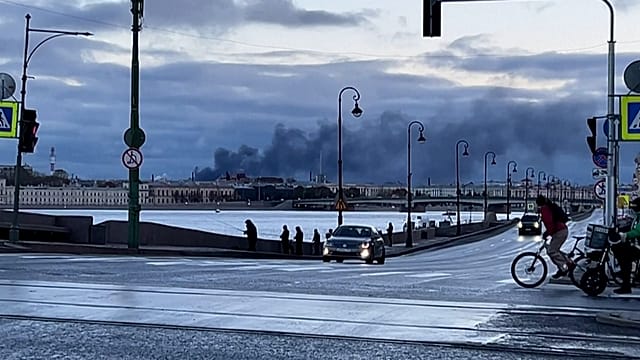


 3 sources
Morning Edition · Monday, October 19, 2026Published at 1:11 AM EDT · New York
Ukraine hits a St. Petersburg oil terminal in a raid Russia says involved more than 1,000 drones
Fires broke out at the city's oil terminal, the Ruchi depot, an Ozon logistics hub and a VK data center, while a Russian ballistic missile killed one person in Kyiv and Zelensky said Patriot interceptors that have already been paid for are delayed.
Ukraine launched a large drone attack on Sunday. Russia's Defense Ministry said it neutralized 1,015 Ukrainian drones over 15 regions, Crimea and the Black Sea. In St. Petersburg, Russia's second-largest city, black smoke rose over industrial and logistics sites, and Russian officials said 126 drones were intercepted over the surrounding region. Leningrad regional governor Alexander Drozdenko gave a higher figure of 145, and said about 20,000 people lost power.
St. Petersburg governor Alexander Beglov said firefighters were fighting fires at the city's oil terminal, the Ruchi oil depot and warehouses in the Kolpinsky district. The online retailer Ozon reported a fire at its logistics hub, and the internet company VK said drones hit its data center in the Leningrad region. Pulkovo airport restricted operations. The Moscow Times reported one person killed and five injured in the city.
Russia kept up its own strikes. A Russian ballistic missile attack on Kyiv killed one person and injured three, according to Ukrinform. Zelensky said the United States is delaying Patriot missiles already paid for under the NATO-run Prioritized Ukraine Requirements List (PURL), at a time when Russia is intensifying attacks on Ukrainian cities and infrastructure. Earlier this year, a NATO official denied that a Patriot shortage was linked to payment delays, so the cause of the current delay is disputed.
Figures from both sides about wartime damage and interception rates are among the least reliable claims available. The two Russian counts for one region already differ. The targets themselves are not in dispute: a Baltic export terminal for petroleum products, a fuel depot, an e-commerce logistics hub and a data center, all hundreds of kilometers from the front.
Part of a tracked trend
Ukraine's Deep Strikes on Russian Energy and Logistics
Ukraine sustains a campaign against Russian refineries and supply lines over the next 3-6 months, pressuring Moscow's oil revenue while Russia retaliates against Ukraine's grid.
Veracity: Corroborated
80/100- If true, who benefits
Kyiv gains leverage against a US-Russian diesel deal it opposes, because the strikes raise Russia's cost of delivering export volumes. Moscow gains by publicizing high interception counts that present its air defenses as effective.
- The nuance
Ukrinform and The Moscow Times confirm the targets and the fires. The count of 1,015 drones is the Russian Defense Ministry's own figure, and nobody has verified it. VK said its services kept operating normally. Zelensky also told Bloomberg he had offered to halt strikes on Russian diesel infrastructure in exchange for more Patriots, so Kyiv is already trading the strikes against the interceptors.
An open-source-intelligence read of how likely this story is true with its real nuance, not a judgment of any outlet. It assesses the claim, weighing independent and adversarial reporting. .
Synthesized from: Africanews · Ukrinform · Kyiv Independent
Townsquare
Start a discussion in Townsquare.
More from this edition
- Trump waives Graham Act sanctions on Russian energy, and Brent falls toward $108
- China's economy grew 4.5% in the third quarter as exports surged and retail sales barely rose
- Gold trades near $4,180 and silver near $58 after Warsh lowers expectations of an October Fed hike
- Putin proposes a summit with Trump and Xi in Shenzhen to negotiate an end to the Ukraine war
- Iran says its seven-day plan to reopen the Strait of Hormuz is still on the table
- Takaichi declines to rule out new government bonds to pay for Japan's food tax cut
- Bank of England examines whether Barclays traders understated private-credit risk to cut capital charges
Comments
0No comments yet.