← The Global Intelligence Brief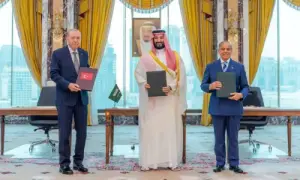


 4 sources
Morning Edition · Friday, November 6, 2026Published at 4:38 AM EST · New York
Turkey's parliament ratifies the Makkah defense pact, committing a NATO member to mutual defense with Pakistan and Saudi Arabia
Lawmakers voted 279 to 119, which clears the way for the three-country agreement to enter into force. It treats an attack on one signatory as an attack on all and bars withdrawal for its first 10 years.
On Thursday, Turkey's Grand National Assembly approved a bill ratifying the Makkah Agreement on Joint Defence with Pakistan and Saudi Arabia, according to Dawn. The vote was 279 to 119, with 398 of the chamber's 592 members voting. Dawn says the vote clears the way for the three-country security pact to enter into force.
Pakistani Prime Minister Shehbaz Sharif, Saudi Crown Prince Mohammed bin Salman and Turkish President Recep Tayyip Erdogan signed the agreement in Makkah on August 7. It treats an armed attack on any signatory as an attack on all three. It builds on the bilateral defense agreement that Pakistan and Saudi Arabia signed in September 2025. ProPakistani reports that Pakistan has already ratified the pact and that members cannot withdraw for 10 years after it takes effect. Pakistan has said the pact is open to new members, and Turkey expects Egypt to join.
The pact creates overlapping commitments. Turkey is a member of the North Atlantic Treaty Organization (NATO) and is bound by its mutual-defense clause. Pakistan has nuclear weapons and a long military rivalry with India. Saudi Arabia faces Houthi missile and tanker attacks on its southern flank. Analysts at India's Vivekananda International Foundation describe the agreement as "geopolitically fragile" but militarily reinforcing. That reading reflects New Delhi's concern about Pakistan gaining two well-funded partners.
The 119 votes against show that the pact does not have unanimous support in Ankara. The sources do not say which parties opposed it.
Part of a tracked trend
Middle Powers Build Security Blocs Outside Washington
States that once relied on American guarantees keep forming their own mutual defense arrangements, redirecting arms procurement away from Western suppliers and creating overlapping commitments that make regional crises harder to contain.
Veracity: Corroborated
85/100- If true, who benefits
Saudi Arabia gains treaty-backed military partners without relying only on Washington, Pakistan gains Gulf financing, and Turkey's defense industry gains a protected export market.
- The nuance
The 279 to 119 vote is confirmed, but Turkish reporting says the collective-defense clause does not take effect automatically and requires consultation, Foreign Minister Hakan Fidan has said Turkey will not send troops against the Houthis, and the pact enters into force only after every signatory completes ratification.
An open-source-intelligence read of how likely this story is true with its real nuance, not a judgment of any outlet. It assesses the claim, weighing independent and adversarial reporting. How we label confidence.
What this means
Synthesized from: Dawn · ProPakistani · Kuwait Times · Vivekananda International Foundation
Townsquare
Start a discussion in Townsquare.
More from this edition
- Asian chip stocks follow the Nasdaq down as investors bet Democratic gains will slow data-center building
- Bank of England raises Bank Rate to 4%, its first increase since 2023, and warns more rises are likely
- Ueno Bank's collapse freezes the savings of about 3 million Paraguayans and forces out the central bank chief
- Brent climbs back toward $100 after new Hormuz tanker attacks but heads for a weekly loss of about 12%
- Washington weighs resuming strikes on Iran on November 9, Fox News reports, as Riyadh denies a $51 billion Houthi demand
- Goldman Sachs cuts its year-end gold forecast to $4,150 as Fed officials argue for more rate increases
- Bitcoin falls to about $75,600 as more than $1 billion in leveraged positions are liquidated
Comments
0No comments yet.